

Saint Paul


 1
3.6
1
3.6
- proper noun
- /seɪnt pɔl/
Loading YouTube…
Watch on YouTubeYou know, you can think about Saint Paul and in Christian terms and the fact that he was a tech maker, that was not a particularly, you know, high class position.
- You know, you can think about Saint Paul and in Christian terms and the fact that he was a tech maker, that was not a particularly, you know, high class position.
Examples
-
You know, you can think about Saint Paul and in Christian terms and the fact that he was a tech maker, that was not a particularly, you know, high class position.
-
Saint Paul traveled extensively to spread the message of Christianity among the Gentiles.
-
In his letter, Saint Paul emphasized the importance of love and unity among believers.
-
Saint Paul wrote several Epistles that are essential readings in the New Testament.
Synonyms
 ∞
3.0
∞
3.0
A Christian leader in the New Testament who taught many people and wrote letters to churches
 15
6.1
15
6.1
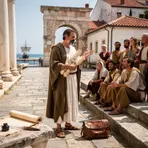
The original name of Paul, a Christian leader
 1
5.7
1
5.7
A Christian missionary who spread Christianity across the Roman world and wrote letters in the New Testament
 1
7.2
1
7.2
A Christian leader who taught non-Jewish people and wrote letters to early churches

A Christian leader from long ago who wrote many letters in the New Testament

The original name of Paul the Apostle, an early Christian missionary and writer
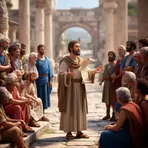
A title for Saint Paul, a Christian leader who spreads Christianity to non-Jewish people
Surface Forms
Morphology
saint + Paul
The phrase is compositionally the title 'Saint' (a holy person) plus the proper name 'Paul', so a learner who knows both constituents will understand it denotes a holy person named Paul. Detailed historical information (apostle, missionary, Epistles) requires background knowledge but does not undermine the straightforward compositional interpretation.
Etymology
Saint Paul was originally called 'Saul'; after a sudden vision he changed his life, became a follower of Jesus, travelled widely and wrote letters to early Christian communities, so he is remembered as a saint.