
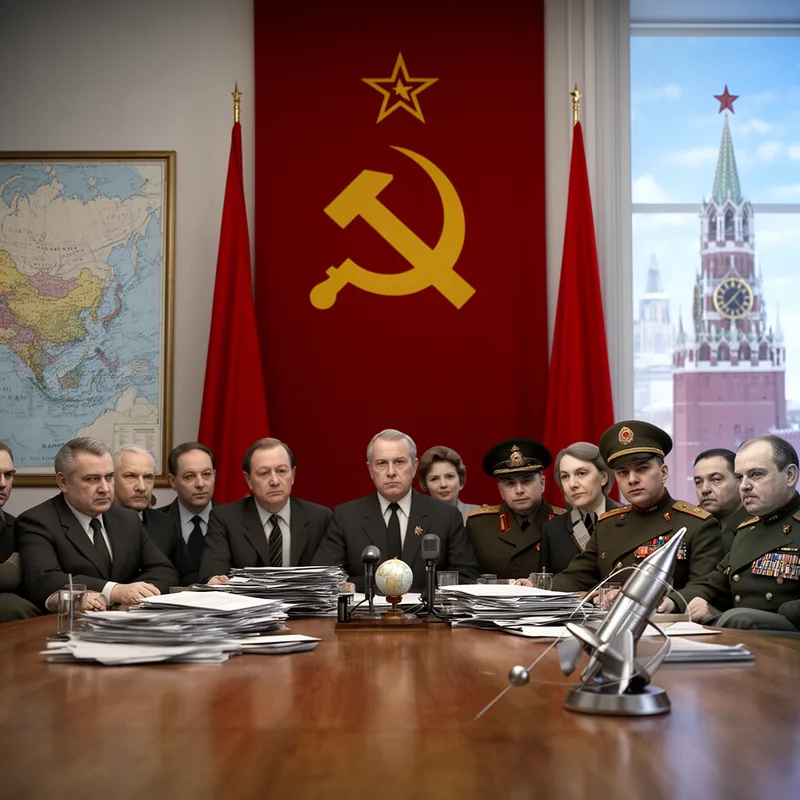
Soviets
- noun
- /ˈsoʊviɛts/
- The Soviets controlled Eastern Europe during the Cold War.
Loading YouTube…
Watch on YouTubeI, I believe the Soviets were realist to the core.
- I, I believe the Soviets were realist to the core.
- And now there's a fear that the Soviets get to the moon first.
- But what it did do is it caused the Soviets to scratch their heads.
- You know, when when John Kennedy was killed, the Soviets came to us within minutes.
- He didn't arrive in in Afghanistan until after the Soviets had departed.
- That's how they knew the Soviets had the bomb.
- So the so Kriegersville, you know, sort of helped the Soviets staunch the German invasion.
- So way back in the Cold War, we find out that the Soviets have lost the sub in the Pacific Ocean.
- But you know, why did the Soviets, why did the Soviet Union collapse it?
- That was the Soviets mandate and they showed their hand right away.
Examples
-
DARPA came out of Sputnik when the Soviets surprised the United States.
-
That's how they knew the Soviets had the bomb.
-
the US says no, but the Soviets stop testing on their own.
-
We knew that the Soviets were, you know, heavily doing this.
-
But the biggest challenge the Soviets face now is Poland.
-
You know, when when John Kennedy was killed, the Soviets came to us within minutes.
-
That was the Soviets mandate and they showed their hand right away.
-
But what it did do is it caused the Soviets to scratch their heads.
-
So when the Soviets invaded, all of the kids went out of school and the Soviets were brutal in Afghanistan.
-
Many people opposed the policies of the Soviets in the 1980s.
Synonyms

 ∞
3.8
∞
3.8

A former country of several republics in eastern Europe and northern Asia, including Russia, that existed from 1922 to 1991
 156
5.3
156
5.3
A walled set of important buildings in Moscow that also means the Russian government
 45
3.8
45
3.8
A former union of communist republics in eastern Europe and northern Asia
 1
7.4
1
7.4
An elected council that runs local government in a communist country

A former large country in eastern Europe and northern Asia with a communist government
Surface Forms
Morphology
Etymology
Soviets comes from the Russian word sovet, which means 'council', a group that gives advice and makes decisions. So Soviets refers to those councils and, by extension, the government or authorities of the Soviet Union.