

Solidago canadensis
- noun
- /ˌsɒlɪˈdeɪɡoʊ kænəˈdɛnɪs/
- Specialized
- The roadside was lined with tall stands of Solidago canadensis, their yellow flowers brightening the autumn landscape.
Examples
-
While Solidago canadensis is attractive to pollinators, it can quickly become invasive if not managed.
-
Gardeners often struggle to control the spread of Solidago canadensis in backyard flowerbeds.
-
The Solidago canadensis blooms beautifully in late summer.
-
Many gardeners consider Solidago canadensis a nuisance plant.
-
Gardeners often struggle to control the spread of Solidago canadensis in backyard flowerbeds.
-
The roadside was lined with tall stands of Solidago canadensis, their yellow flowers brightening the autumn landscape.
-
While Solidago canadensis is attractive to pollinators, it can quickly become invasive if not managed.
Synonyms

A tall North American plant with many small yellow flowers in large groups
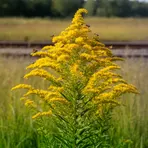
A tall North American plant with bright yellow flower groups on curved stems, often seen as a weed
Surface Forms
Morphology
This is a scientific binomial composed of a genus name 'Solidago' (a type of daisy-family plant with yellow flowers) plus the species epithet 'canadensis' (indicating origin from Canada). The meaning is directly compositional and follows a systematic taxonomic pattern familiar across languages, so a learner who knows both constituents can infer it refers to a Solidago plant from Canada/North America.
Etymology
Solidago canadensis gets its name from Latin: Solidago means 'to make whole' because people once used goldenrod as a simple healing herb, and canadensis means 'from Canada'. So the name points to a yellow wildflower once used in folk medicine and originally from North America.

