
Solanum melongena
- noun
- /səˈleɪnəm mɛˈlɒnɡɪnə/
- Specialized
- Did you know that Solanum melongena is also called eggplant?
Examples
-
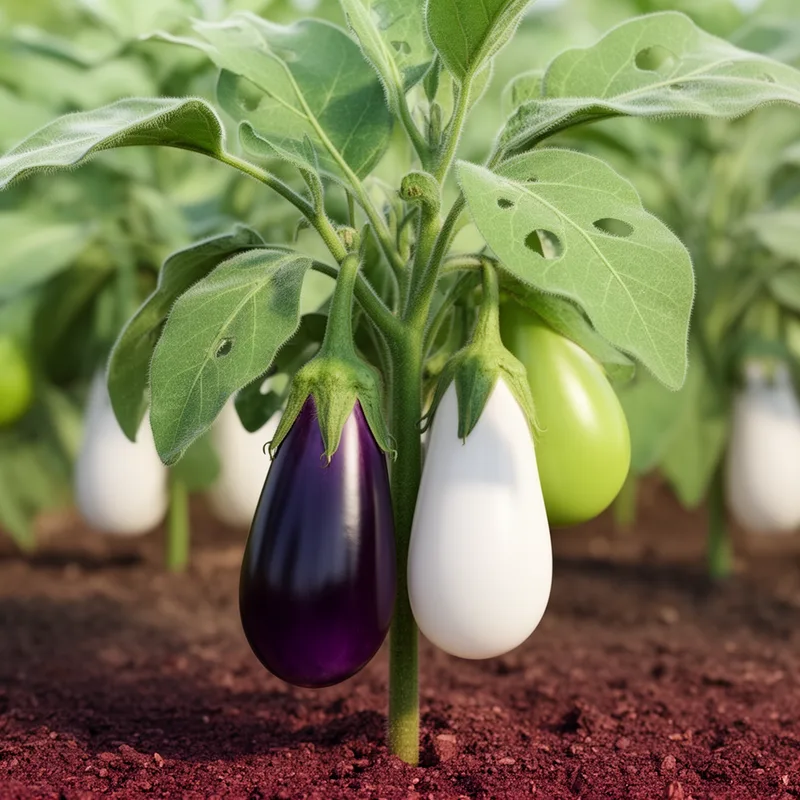
Modern varieties of Solanum melongena produce fruit in purple, white, or green.
-
Did you know that the fruit of Solanum melongena is often used in various cuisines around the world?
-
Farmers in Southeast Asia have cultivated Solanum melongena for centuries.
-
The leaves of Solanum melongena are broad and slightly hairy.
-
I bought a fresh Solanum melongena at the market.
-
Farmers in Southeast Asia have cultivated Solanum melongena, also known as eggplant, for centuries.
-
I bought a fresh Solanum melongena at the market to use in my favorite recipe.
Synonyms

 54
1.0
54
1.0

A purple vegetable with shiny skin that you can eat
 1
5.4
1
5.4
A hairy tall plant that produces large purple fruits you can eat


 1
8.4
1
8.4
A purple vegetable like an eggplant that you cook and eat

A large purple vegetable with shiny skin that you cook and eat

A short upright plant that grows large glossy purple eggplants used as a vegetable
Surface Forms
Morphology
Solanum + melongena
This is a Latin binomial (scientific) name: 'Solanum' signals a genus label and 'melongena' is not a common English word, so a B1 learner who only knows these constituents would not infer the everyday meaning 'eggplant/aubergine'. Scientific Latin names are conventional and arbitrary rather than compositional, so the referent is not derivable from the parts.
Etymology
Solanum melongena is the Latin name for the eggplant. The first part, Solanum, was a name for nightshade plants. The second part, melongena, may come from an old word for a round fruit like a 'melon', because early farmers thought the eggplant looked like a small melon, so the name points to the plant and its fruit.