
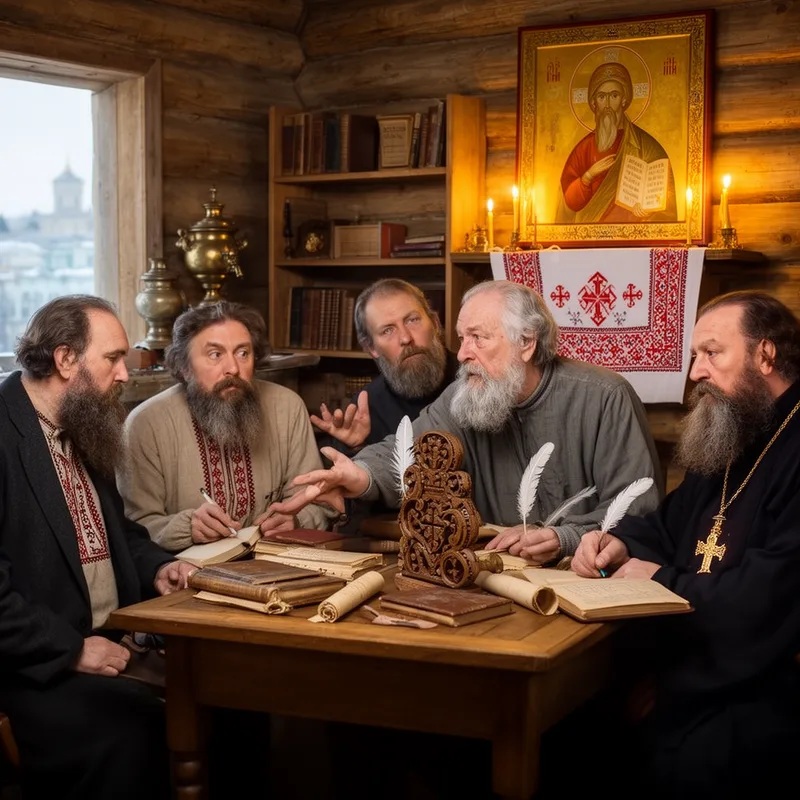
Slavophilism
- noun
- /slɑːˈvɒfɪlɪzəm/
- In the 19th century, Slavophilism inspired many intellectuals to promote traditional Slavic values in Russian society.
Examples
-
The revival of Russian orthodoxy could even be interpreted as a reflection of a resurgent Slavophilism in Soviet policy during the Gorbachev era.
Academic text (1993) -
Slavophilism and the unwitting glorification of the motherland are beyond his ken and beneath his dignity both as a Christian and as a Russian.
Academic text (1991) -
The principles of Slavophilism emphasized the importance of community and faith in shaping the future of Russia.
-
Many artists and writers were influenced by Slavophilism, advocating for a return to authentic Russian culture.
Synonyms

A strong love for the people, culture, and traditions of Slavic countries
Surface Forms
Morphology
Slavophilism = Slavophile (semi-transparent) = Slav + phil + ism
Forming a doctrine or movement by adding the productive suffix '-ism' to 'Slavophile' is a standard, regular process.
Etymology
Slavophilism comes from parts meaning 'Slav' and 'love': Slavo- for the Slavic people, as in Slavic, and -philism from a root meaning 'love', like in philosophy. So, Slavophilism is the idea of loving and supporting Slavic traditions and wanting society to follow them.

