
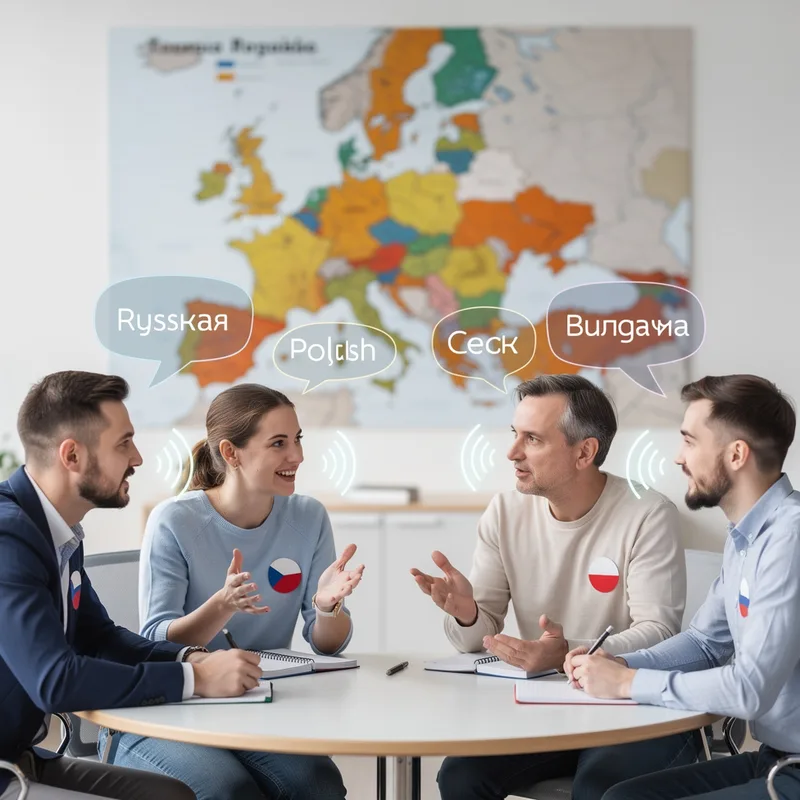
Slavic language
 1
4.6
1
4.6

- noun
- /ˈslævɪk ˈlæŋɡwɪdʒ/
 :
idioma eslavo
:
idioma eslavo
- The majority of peoples in Rosland were the Eastern Slavs, who spoke the Old E Slavic language from which modern Russian, Ukrainian, and Belarusian stem.
You know, Serbian, these are Slavic languages.
- You know, Serbian, these are Slavic languages.
- So as Slavic speakers, they generated A Slavic language which we now call Old Church Slavonic.
- Well, how do you say like Charles in a Slavic language, Any, any Slavic language Coddle coddle is good.
Examples
-
In this posthumous collection of Pomorska's essays on Slavic language and literary theory, Baran includes a broad selection of her work on Roman Jakobson's theories of poetics.
Academic text (1993) -
This bibliography includes Todorov's translations of works from Slavic languages into French.
Academic text (1997) -
The term comes from Slavic languages and should not be confused with the English term protection.
Academic text (1996) -
[Woman singing in Slavic language]
-
Here, Wermusch's Slavic languages and scholarly interest in the early history of eastern Germany came into play.
Academic text (2003) -
So as Slavic speakers, they generated A Slavic language which we now call Old Church Slavonic.
-
Well, how do you say like Charles in a Slavic language, Any, any Slavic language Coddle coddle is good.
-
This ear traditionalists often explain later borrowed from the Russian language as the common heritage of both the old East Slavic languages while at the same time denying any link between the Old Belarusian language and novobelorusski periods.
Blog text (26) -
Gary Saul Morson is the Frances Hooper Professor of the Arts and Humanities and professor of Slavic languages at Northwestern University, Evanston, IL 60208-2206.
Academic text (1992) -
I can understand written texts in several Slavic languages like Polish and Czech.
Synonyms

 1
6.0
1
6.0
A group of related languages spoken in Eastern Europe like Russian or Polish
 1
8.9
1
8.9
A group of related languages like Russian, Polish and Czech spoken in Eastern Europe and northern Asia

A group of related languages spoken in Eastern Europe and parts of Asia, including Russian, Polish and Czech
Surface Forms
Morphology
The meaning is directly compositional: 'Slavic' (relating to Slavic peoples/languages) modifies 'language', yielding 'a language of the Slavic family.' This adjective+noun pattern is regular and cross-linguistically transparent, so a B1 learner who knows both constituents will understand the MWE.
Etymology
Slavic language may come from the name the Slavic people used for themselves; Slavic points to that group and language means 'the way they spoke'. So it refers to the family of related languages like Russian, Polish and Czech that came from the same original language.