
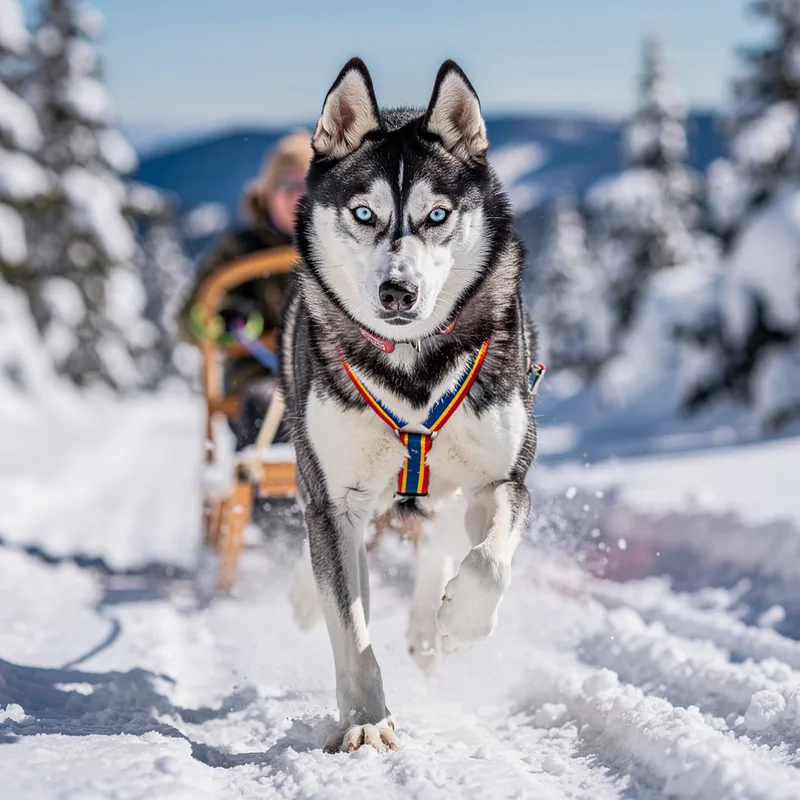
Siberian husky
 1
2.3
1
2.3

- noun
- /ˈsaɪbɪrɪən ˈhʌski/
- Someday, I want to travel with my friends again to Europe, read every book on the planet, and retire to a cottage in the woods with my own beautiful pond and the dog of my dreams, a Siberian husky.
Loading YouTube…
Watch on YouTubeThis dog is going to be the Husky, Siberian Husky.
- This dog is going to be the Husky, Siberian Husky.
Examples
-
As a sled dog, the Siberian husky is known for its strength and endurance.
-
And you could take your Siberian Husky as your work dog.
-
For all she knows, I got a sled and ten Siberian huskies.
-
If you take care of your pet pug, beagle, Siberian husky, or even if it is a chihuahua, it will always follow you around.
Blog text (4) -
A month after the shouting match, Hector and Gina would bring home a Siberian husky puppy, and I would throw them out, and that would be the end of that.
Fiction book (1996) -
What I don't tell them is that I once saw a Siberian husky called Bear run over by a lumber truck, flatbed strapped with skinned trees.
Fiction book (1996) -
My friend adopted a Siberian husky because they are great sled dogs.
-
The children played outside with their new Siberian husky in the snow.
How Strong
2
3.1
 1
2.3
4
2.7
23
1.3
11
3.3
1
2.3
4
2.7
23
1.3
11
3.3
Surface Forms
Morphology
The meaning is directly and transparently derived from 'Siberian' (from Siberia) modifying 'husky' (a strong, thick-coated sled dog), so a B1 learner who knows both words will infer it denotes a dog breed from Siberia. This adjective + noun, origin + animal type composition is cross-linguistically common and not idiomatic, making the expression immediately understandable.
Etymology
Siberian husky: The name Siberian husky comes from where the dogs began in 'Siberia', with Siberian showing the region and husky meaning a strong, cold-weather dog. Because these dogs pulled 'sleds' and had thick coats, the name now refers to the medium-sized sled dog breed we know today.