
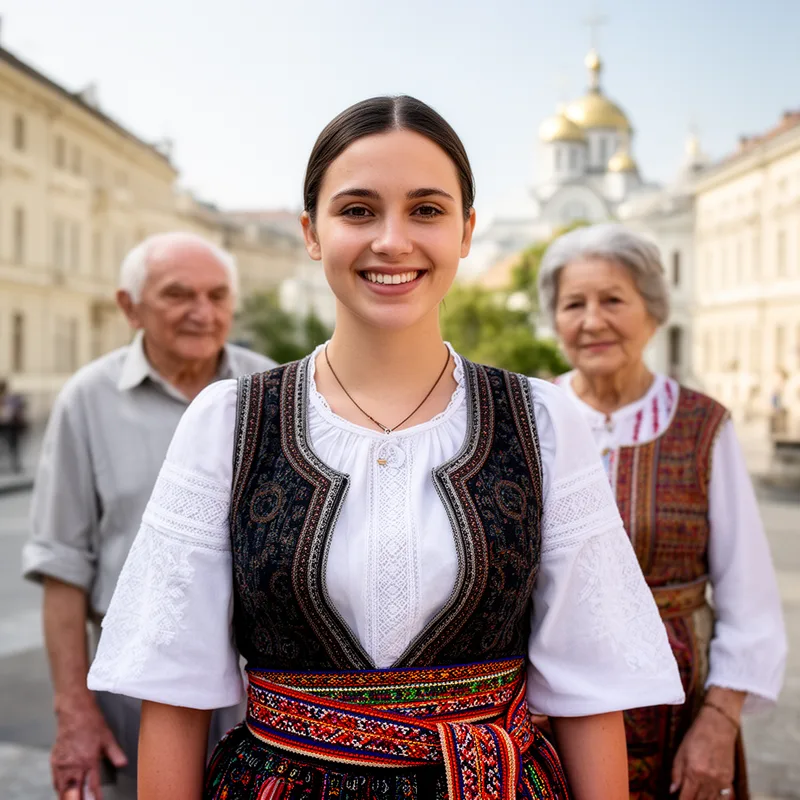
Serbian
- noun
- /ˈsɜrbiən/
- The Croatians are Catholics, the Serbians are Orthodox.
Loading YouTube…
Watch on YouTubeThe Croatians are Catholics, the Serbians are Orthodox.
- The Croatians are Catholics, the Serbians are Orthodox.
- Why should I go and fight because the Austrians and the Germans and the Serbians are at each other's throats.
Examples
-
Why should I go and fight because the Austrians and the Germans and the Serbians are at each other's throats.
-
And it was to kick all the Serbians out of Kosovo into Serbia.
-
From his youth, Stepas Stepanovich's influence on Serbian society is enormous.
-
That winter, the remnants of the Serbian army escaped through the Albanian mountains.
-
That winter, the remnants of the Serbian army escaped through the Albanian mountains.
-
And there's also the, a really important site of the battle of, of Kosovo, which was led by Serbian Prince Lazar.
-
He managed to unite the local Albanian and Serbian Lords in the League of Leisure, thus forming a strong alliance against his former masters.
-
The Serbs and French up against gargantuan odds in Serbia as the Serbian civilian population flees toward the mountains of Albania.
-
Almost all Serbian and Bulgarian aristocrats became the vassals of Murad, among them the Prince of Moravian Serbia, Lazar.
-
Stepan is proud of his Serbian heritage and enjoys celebrating the traditional festivals.
Synonyms
 242
3.4
242
3.4

A person whose family comes from Serbia or nearby countries
Surface Forms
Morphology
Etymology
Serbian comes from the name of the people, the Serb, an old Slavic group. So a Serbian is a person who belongs to that people or who has their heritage.