
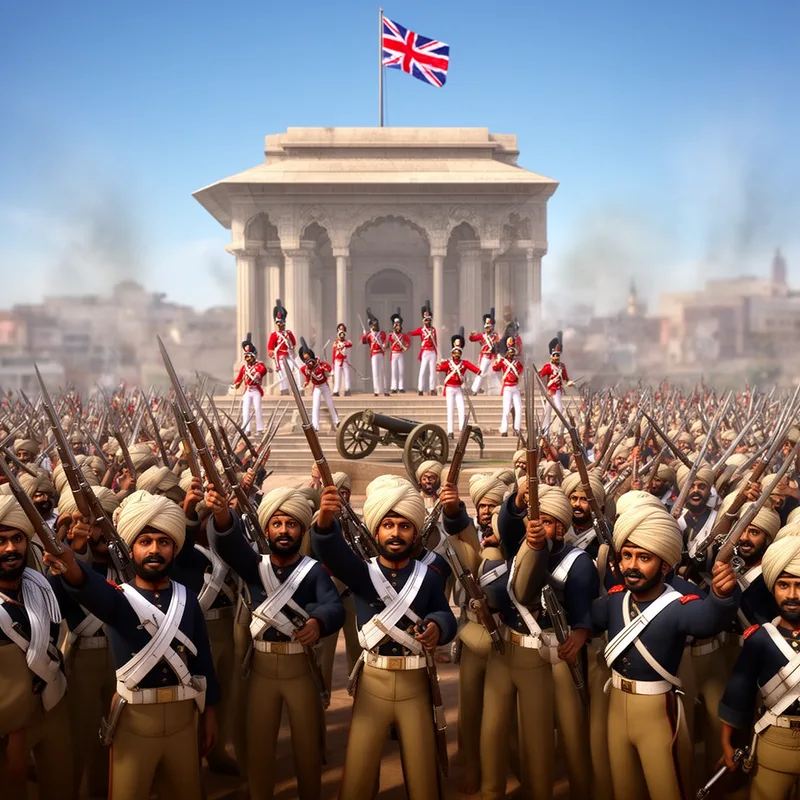
Sepoy Mutiny
- noun
- /sɪˈpɔɪ ˈmjuːtɪni/
- Many historians regard the Sepoy Mutiny as the first war of Indian independence against colonialism.
Examples
-
The Sepoy Mutiny marked a significant turning point in India's struggle for independence from British rule.
-
Back in 1858, after the Sepoy Mutiny, she had, after all, insisted on rewriting the proclamation to the Indian people that her ministers had drafted on her behalf.
Academic text (1997) -
In 1857, the Sepoy Mutiny began when Indian soldiers revolted against the policies of the British East India Company.
Synonyms

A large uprising by Indian soldiers and other people against British rule in 1857 and 1858

A major revolt against British rule in India in 1857 and 1858
Surface Forms
Morphology
The phrase literally combines 'sepoy' (an Indian soldier) and 'mutiny' (a rebellion by soldiers), so a learner who knows those words can infer it refers to a rebellion carried out by sepoys. Although it names a specific 1857–58 historical event, the basic meaning is compositionally transparent and follows a common noun + noun event-naming pattern cross-linguistically.
Etymology
Sepoy Mutiny comes from the word sepoy (an Indian 'soldier') and mutiny (a soldier's 'rebellion'). In 1857 many Indian soldiers working for the British rose up and fought, so the name was used for that big revolt against British rule.

