

Indian Mutiny
- noun
- /ˈɪndiən ˈmjuːtəni/
- Archaic
- The Indian Mutiny of 1857 was a significant turning point in India's struggle against British rule.
- the Indian Mutiny of 1857
Examples
-
What do you want to do, start the Indian Mutiny again?
-
And memories of the Paris Commune (1848), the Indian Mutiny of 1857, and the American Civil War (1861-65) are still fresh and raw.
Blog text (25) -
Many historians consider the Indian Mutiny to be a pivotal moment that led to the end of the British East India Company's rule.
-
During the Indian Mutiny, widespread uprisings across northern India changed the course of colonial history.
Synonyms

 150
5.1
150
5.1

A group of people who rise up and use force to oppose the government
 128
4.1
128
4.1
A group of people who use weapons to fight the government
 79
7.9
79
7.9
An open rebellion by soldiers or sailors against their officers
 73
4.6
73
4.6
A violent attempt to remove a government or ruler
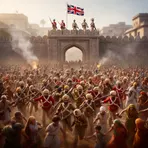
A large uprising by Indian soldiers and other people against British rule in 1857 and 1858

A large 1857–1858 uprising of Indian soldiers against British rule
Surface Forms
Morphology
The designation 'Indian Mutiny' is compositionally built from 'Indian' (relating to India) + 'mutiny' (a rebellion), so a learner who knows both words can infer it refers to a rebellion in India. While the precise historical details (dates, parties involved) require background knowledge, the core meaning is directly derivable from the constituents and thus accessible to B1 learners.
Etymology
Indian Mutiny comes from the British name for the big 1857–58 uprising, because it began when many Indian soldiers in the British army refused orders and fought their officers, so they called it a mutiny and used the word mutiny to mean 'to rebel'.