

Senecio douglasii
- proper noun
- Specialized
 :
Senecio douglasii
:
Senecio douglasii
- The bluish-green leaves and woolly texture make Senecio douglasii easily identifiable in the wild.
Examples
-
Ranchers are cautious of Senecio douglasii because it is toxic to cattle and sheep.
-
Many hikers admire the bright yellow flowers of Senecio douglasii while exploring the desert.
-
Senecio douglasii is commonly found in sandy soils across the southwestern United States.
-
The Senecio douglasii thrives in arid conditions.
-
Farmers should avoid planting Senecio douglasii near their livestock.
-
Senecio douglasii is toxic to livestock, so ranchers must keep it away from their animals.
-
It is important for farmers to recognize Senecio douglasii in order to protect their cattle.
Synonyms
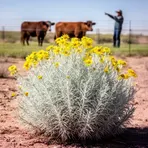
A bushy plant with narrow leaves covered in white hairs and yellow flowers that is poisonous to farm animals
Surface Forms
Morphology
Senecio + douglasii
This is a taxonomic binomial (genus + specific epithet), so a learner who knows 'Senecio' as a plant genus can infer that Senecio douglasii is a species of that genus; however the specific epithet 'douglasii' carries no transparent lexical meaning (it is a proper name/patronym) and the detailed properties (appearance, toxicity) are not derivable from the parts. Because the genus gives partial compositional information but the full referential meaning remains non-predictable, the expression is best classified as semi-transparent.
Etymology
Senecio douglasii gets its name from two sources: Senecio comes from Latin meaning 'old man' because the plant has white, woolly hairs like a beard, and douglasii is 'named for' the plant collector David Douglas who found many western plants. That's why the name both describes the plant's woolly look and remembers the explorer who collected it.

