
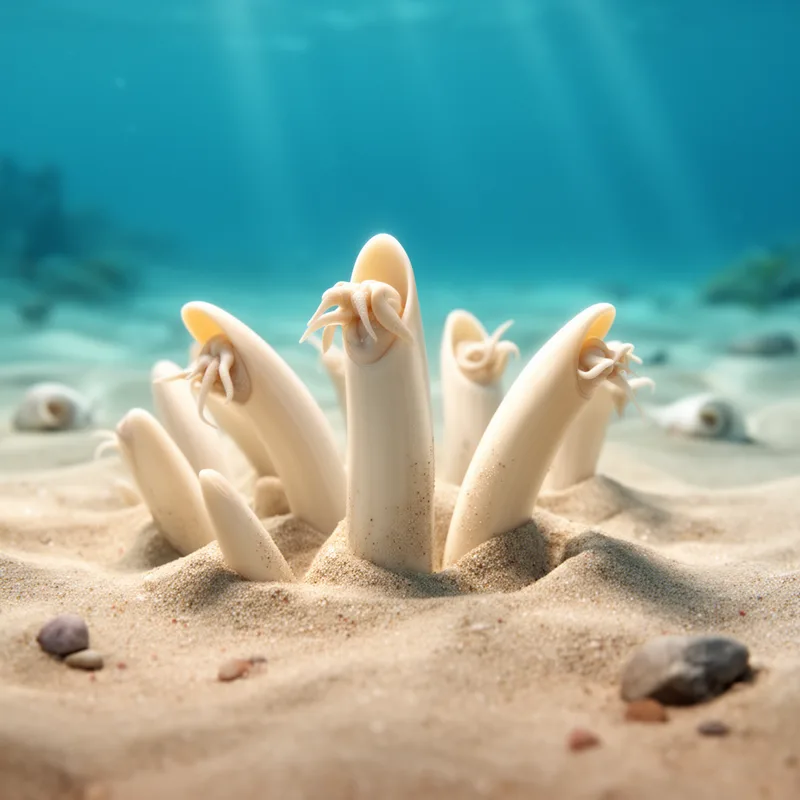
Scaphopoda
- noun
- /ˌskæfəˈpoʊdə/
- Specialized
- The Scaphopoda are easily identified by their elongated, tubular shells.
Examples
-
Researchers collected several specimens of Scaphopoda from the sandy ocean floor.
-
Fossils of Scaphopoda provide valuable information about ancient marine environments.
-
The Scaphopoda are fascinating creatures found in oceanic environments.
-
Many Scaphopodas can be found buried in sandy substrates.
-
Researchers collected several specimens of Scaphopoda from the sandy ocean floor.
-
Fossils of Scaphopoda provide valuable information about ancient marine environments.
-
The Scaphopoda are easily identified by their elongated, tubular shells.
Synonyms

A sea animal that has a long thin shell open at both ends and a foot for digging in sand
A small sea animal with a long tube-shaped shell open at both ends

A sea animal with a long tube-shaped shell like a tusk that burrows in sand

A small sea animal with a long, curved tube-shaped shell
Surface Forms
Morphology
Scaphopoda = scapho + poda
A taxonomic formation from Greek combining forms ('scapho-' + '-poda') that are not standalone English words and whose technical meaning ('tusk/boat-shaped foot') is not recoverable by an average B1 learner.
Etymology
Scaphopoda comes from Greek parts skaphē ('boat') and -poda ('foot'). Think of it as 'boat-foot': these sea animals have a soft 'foot' and a long, curved shell like a tiny boat or tusk, so we call them 'tooth shells'.

