
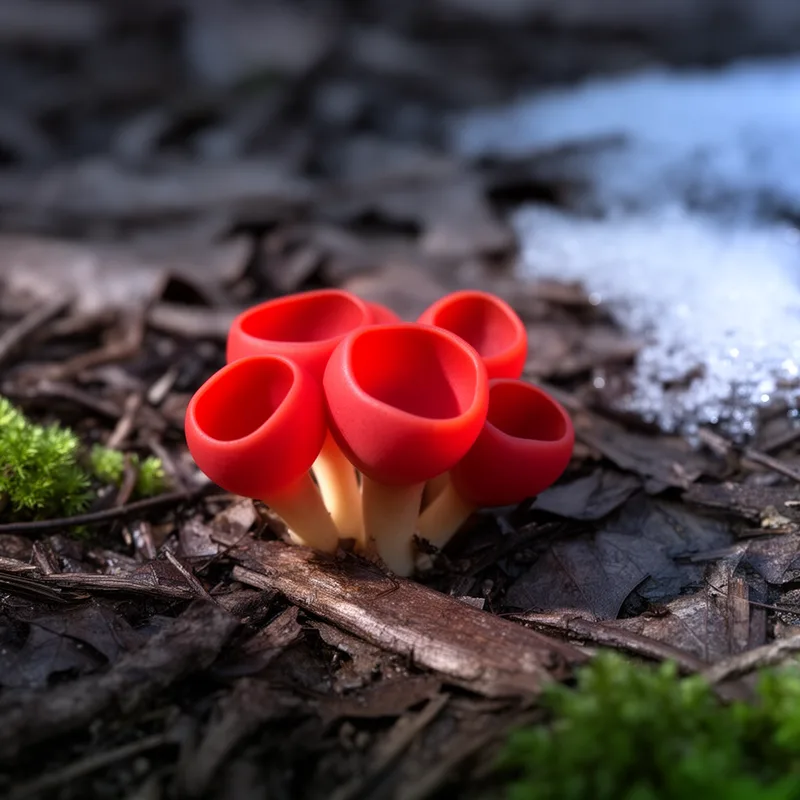
Sarcoscypha coccinea
- noun
- Specialized
- The forest floor was dotted with the vivid red cups of Sarcoscypha coccinea after the last frost.
Examples
-
The striking appearance of Sarcoscypha coccinea often draws the attention of spring hikers.
-
Mycologists collected specimens of Sarcoscypha coccinea to study their role in woodland ecosystems.
-
Look! A Sarcoscypha coccinea!
-
I spotted a Sarcoscypha coccinea in the forest.
-
The forest floor was dotted with the vivid red cups of Sarcoscypha coccinea after the last frost.
-
The striking appearance of Sarcoscypha coccinea often draws the attention of spring hikers.
-
Mycologists collected specimens of Sarcoscypha coccinea to study their role in woodland ecosystems.
Synonyms

A small bright red mushroom shaped like a cup that appears in early spring

A small bright red mushroom with a cup-shaped body
A small bright red mushroom with a cup-shaped body that grows in woods
Surface Forms
Morphology
Sarcoscypha + coccinea
This is a Latin binomial made of non‑English lexical items ('Sarcoscypha' and 'coccinea') with no ordinary-word meanings available to a B1 learner, so knowing the constituents would not allow them to infer 'a bright red, saucer-shaped fungus'. Scientific names follow taxonomic conventions rather than transparent English composition, so the meaning is opaque without specialist or encyclopedic knowledge.
Etymology
Sarcoscypha coccinea may come from Greek and Latin words: the parts sarco and scypha mean 'flesh' and 'cup', and coccinea means 'red'. So the name gives the image of a bright red, cup-shaped mushroom that appears in early spring.

