
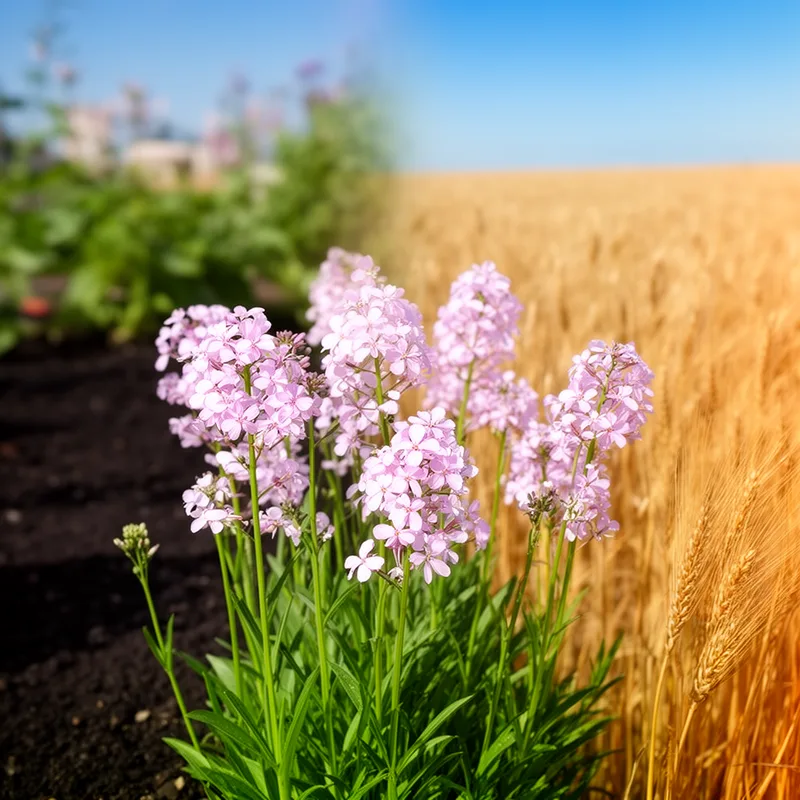
Saponaria vaccaria
- noun
- Specialized
- Saponaria vaccaria produces clusters of pale pink flowers that brighten summer gardens.
Examples
-
Many gardeners love the Saponaria vaccaria for its delicate flowers.
-
Farmers sometimes find Saponaria vaccaria growing as a weed among their grain crops.
-
In North America, Saponaria vaccaria has spread beyond ornamental gardens into wild fields.
-
The Saponaria vaccaria blooms beautifully in spring.
-
Saponaria vaccaria is often planted in gardens for its beautiful clusters of pale rose-colored flowers.
-
Many gardeners cultivate Saponaria vaccaria because it adds a lovely touch to flower beds in the summer.
-
You can easily spot Saponaria vaccaria in fields and gardens with its striking pale pink blossoms.
Synonyms

A small European plant with pale pink flowers often grown in gardens or found in grain fields

A small European annual wildflower with pale rose-colored blooms often in grain fields and gardens
A European annual plant with pale pink flowers often grown in gardens or a weed in grain fields

A small European annual plant with pale pink flowers that often grows as a weed in grain fields
Surface Forms
Morphology
This is a Latin binomial composed of two botanical genus terms; a learner who knows 'Saponaria' (herbs that produce a soapy lather) and 'Vaccaria' (an herbaceous flowering genus) can infer it denotes a flowering plant species related to those genera. Botanical names are taxonomic and therefore largely compositional and cross-linguistically recognizable, making the overall meaning directly derivable from the constituents.
Etymology
Saponaria vaccaria comes from old Latin words: Saponaria meaning 'soap' and vaccaria meaning 'cow'. The plant's roots and leaves make a soapy foam when rubbed and it often grew near farms, so the name paints the picture of a 'soap' plant tied to 'cows' and explains why we call it cow soapwort.

