

Samia walkeri
- noun
- Specialized
- The larvae of Samia walkeri have become a concern for foresters due to their impact on ailanthus trees.
Examples
-
Scientists are studying how Samia walkeri has adapted to environments in the United States.
-
I spotted a beautiful Samia walkeri moth resting on a leaf during our hike.
-
Look at that stunning Samia walkeri!
-
The Samia walkeri is known for its striking appearance.
-
I spotted a beautiful Samia walkeri moth resting on a leaf during our hike.
-
The larvae of Samia walkeri have become a concern for foresters due to their impact on ailanthus trees.
-
Scientists are studying how Samia walkeri has adapted to environments in the United States.
Synonyms
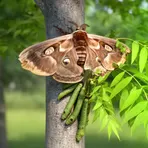
A large moth from Asia whose caterpillars eat a tree called ailanthus

A large moth from Asia with caterpillars that eat the ailanthus tree
Surface Forms
Morphology
Samia + walkeri
This is a scientific binomial: 'Samia' names the genus (moths) but 'walkeri' is a species epithet that functions as an arbitrary label (often commemorative) rather than a meaningful descriptor. Knowing the parts as words does not allow a learner to infer specifics like size, native range, or larval host, so the overall meaning is not predictable from the constituents.
Etymology
Samia walkeri comes from how scientists name animals: Samia is the moth group and walkeri probably honors a person named Walker who first found or described the moth. So the name points to a particular large Asian moth whose 'caterpillars' eat the ailanthus tree.

