

Samia cynthia
- noun
- Specialized
- The Samia cynthia is often cultivated for its silk-producing abilities.
Examples
-
The lush mulberry leaves were quickly consumed by the hungry Samia cynthia larvae.
-
Entomologists studied the life cycle of Samia cynthia in a controlled environment.
-
The Samia cynthia is known for its vibrant green color.
-
Farmers cultivate Samia cynthia for its silk production.
-
Entomologists studied the life cycle of Samia cynthia to understand its role in silk production.
-
Farmers carefully gather Samia cynthia cocoons to harvest the silk fibers used in textiles.
-
The Samia cynthia larvae thrive on mulberry leaves, which provide essential nutrients for their growth.
Synonyms
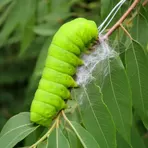
A large bright green caterpillar that eats the leaves of the ailanthus tree and makes silk
Surface Forms
Morphology
Samia + cynthia
This is a scientific Latin binomial (genus + species). A learner who knows 'Samia' can infer the phrase names a type of Samia moth, but the species epithet 'cynthia' has no ordinary lexical meaning and taxonomic naming conventions are specialist knowledge, so the full specific meaning (a large green silkworm cultivated for silk) is not predictable.
Etymology
Samia cynthia also names the big green silkworm, the caterpillar stage of the cynthia moth that farmers kept because it makes useful silk. Because the larvae spin silk and were kept for that purpose, the name came to mean 'a silk-producing silkworm'.

