
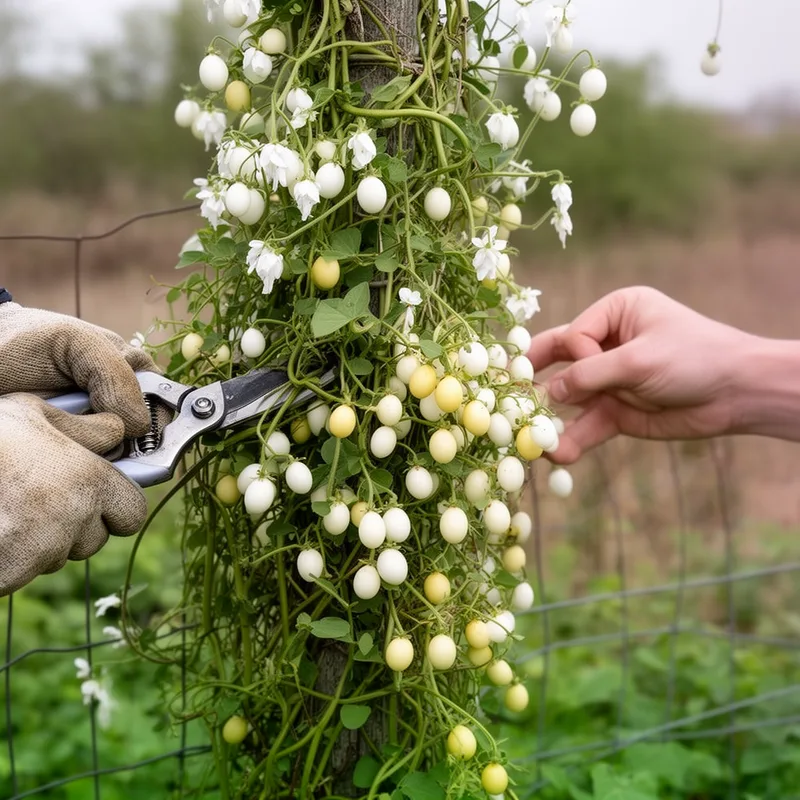
Salpichroa organifolia
- noun
- Specialized
- In the wild, Salpichroa organifolia produces white flowers that turn into small egg-shaped fruits.
Examples
-
The white berries of Salpichroa organifolia can be mistaken for edible fruit, but they are not safe to eat.
-
The invasive Salpichroa organifolia has spread across parts of southern Australia, outcompeting native vegetation.
-
Gardeners often struggle to control Salpichroa organifolia due to its aggressive growth and tolerance to various soils.
-
The Salpichroa organifolia is often found in disturbed areas.
-
Many gardeners consider Salpichroa organifolia a troublesome weed.
-
The invasive Salpichroa organifolia chokes out other plants in gardens and natural habitats.
-
Gardeners often find Salpichroa organifolia difficult to remove because of its rapid growth.
Synonyms
A wild climbing plant with white flowers and egg-shaped white or yellow fruit
A climbing weed plant from Argentina with single white flowers and egg-shaped white or yellow fruit
Surface Forms
Morphology
Salpichroa + organifolia
This is a scientific Latin binomial (genus + species epithet) functioning as a proper name, not a compositional English phrase. A B1 learner who knows the listed constituents (and with 'organifolia' undefined) would not be able to derive the botanical description from the parts; botanical Latin and taxonomic names are language-specific conventions rather than transparent English compositions.
Etymology
Salpichroa organifolia may come from old words meaning 'trumpet' for Salpichroa and 'leaf' for organifolia. That image of trumpet-shaped white flowers and noticeable leaves explains why the name describes the plant's shape.

