
Salix discolor
- noun
- Specialized
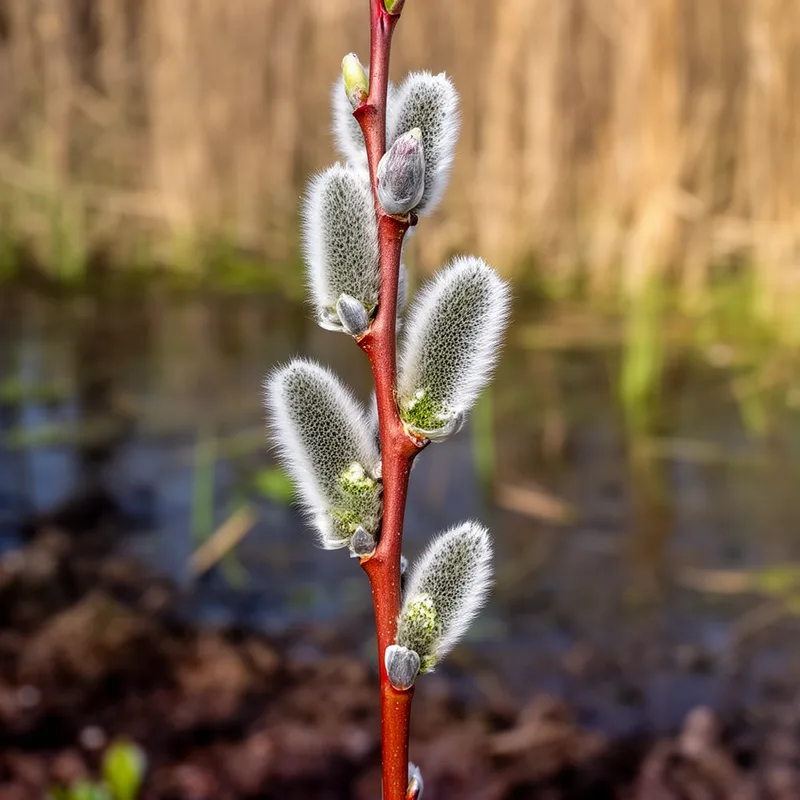
- In early spring, Salix discolor produces silvery catkins before its leaves emerge.
Examples
-
The Salix discolor is often called the American pussy willow because of its furry catkins.
-
Gardeners sometimes plant Salix discolor for its ornamental value in wetland gardens.
-
The Salix discolor tree grows near the riverbank.
-
Have you seen the Salix discolor in bloom this spring?
-
Gardeners sometimes plant Salix discolor for its ornamental value in wetland gardens.
-
In early spring, Salix discolor produces silvery catkins before its leaves emerge.
-
The Salix discolor is often called the American pussy willow because of its furry catkins.
Surface Forms
Morphology
The binomial is compositionally interpretable: 'Salix' names the willow genus and 'discolor' suggests altered or different colouring, so a learner who knows both constituents can infer this refers to a type of willow with a colour-related characteristic. However, as a Latin scientific name (a lexicalized proper noun) the precise species traits (native range, greyish leaves, silky catkins) are not predictable from the parts alone, so the transparency is partial.
Etymology
Salix discolor comes from Latin: Salix means 'willow' and discolor means 'different colour', which creates the image of its greyish leaves and silvery, furry catkins. So the name points to this small North American willow whose soft catkins appear before the leaves.

