
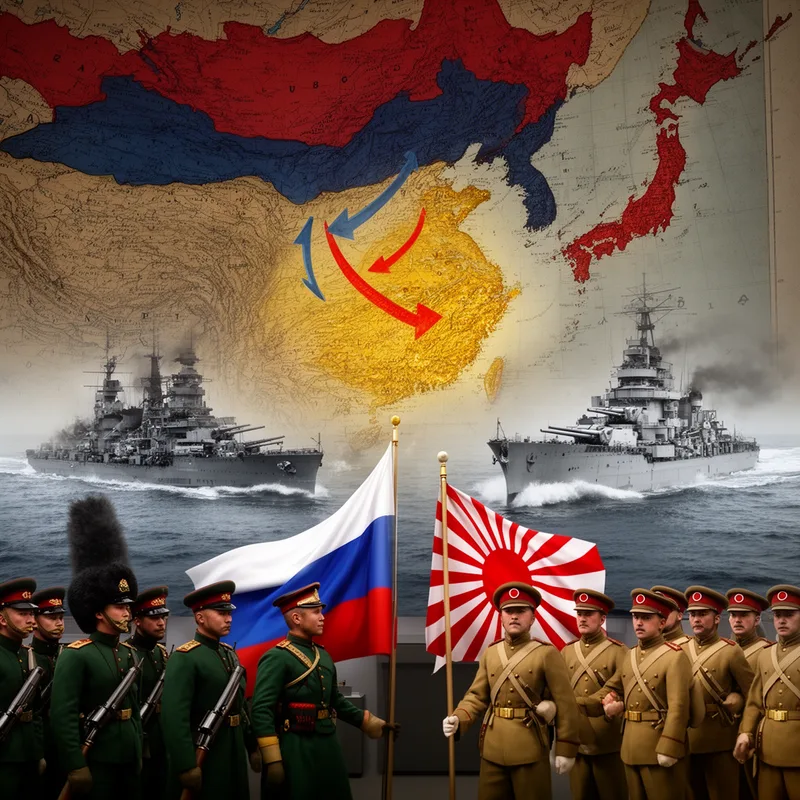
Russo-Japanese War
 1
6.7
1
6.7

- noun
- /ˈrusoʊ dʒəˈpeɪnɪz wɔr/
- As it turned out, the Russo-Japanese War laid the groundwork for Japan's subsequent annexation of Korea, a move that came formally in 1910.
- the Russo-Japanese War of 1905
- the Russo-Japanese War of 1904
Examples
-
The escalating Japanese-Russian rivalry over Manchuria culminated in the Russo-Japanese War of 1904-05.
Academic text (2002) -
The peak glory of the Meiji era was Japan's victory in 1905 in the Russo-Japanese War.
Academic text (1990) -
In the Russo-Japanese War, the European powers were supposed to stay neutral.
Academic text (2008) -
In the Russo-Japanese War, Japan was the weaker party and made the first strike against Russia.
Academic text (1994) -
Roosevelt negotiated an end to the Russo-Japanese War, for which he won the Nobel Peace Prize.
Blog text (28) -
Relations in particular warmed with Britain, which supported Japan in the Russo-Japanese War.
Academic text (2005) -
The money was needed to pay the Empire's debts for the failed Russo-Japanese War.
Fiction book (1992) -
The Treaty of Portsmouth ending the Russo-Japanese War was concluded in September 1905.
Academic text (2010) -
Japan became accepted as a "civilized country" partly because of its defeat of Russia in the Russo-Japanese War (1904-1905).
Academic text (2016) -
The victory of Japan in the Russo-Japanese War marked a significant shift in global power dynamics.
Surface Forms
Morphology
Russo-Japanese + war
The compound 'Russo-Japanese' transparently links Russia and Japan, and combined with 'war' clearly denotes a war involving those two countries. Although it is a historical proper name, the constituent meanings (Russia + Japan + war) follow a common cross-linguistic compositional pattern that a B1 learner who knows the country names and 'war' can readily infer.
Etymology
Russo-Japanese War is a name that joins the two country names Russia and Japan to show who fought. It refers to the '1904 to 1905' war when Japan defeated Russia and gained control of Korea and Manchuria, so the name points to that specific war.