

Russian language
 2
2.7
2
2.7

- noun
- /ˈrʌʃən ˈlæŋɡwɪdʒ/
- The Russian language has also remained the lingua franca even in Central Asian Turkic republics.
Loading YouTube…
Watch on YouTubeYou know that Russian language is not persecuted in Ukraine.
- You know that Russian language is not persecuted in Ukraine.
- And I, I, I, I think the censorship on external websites has been a lot more rigorous on Russian language outlets.
Examples
-
Today well announce the results of our Russian language contest.
-
Even if existing programs could be found, they would need to be modified to work with the Russian language.
Academic text (1993) -
Ukraine is a political state where the second language in importance and spread is the Russian language.
-
The first professor I had for the Russian language in college was from Ukraine.
Fiction book (1999) -
This continued emphasis on Russian language and cultural expressions also included the second generation.
Academic text (2006) -
Another encouraging observation: the more they learned of the Russian language, literature, and culture, the stronger their curiosity was about American Studies.
Academic text (2003) -
"The Russian language is disappearing from the lives of the younger generations outside Russia," she observes.
Academic text (1998) -
In 2006, 24,845 students at American universities were enrolled in Russian language courses, compared to a high of 44,626 students in 1990.
Academic text (2010) -
A Lieutenant Colonel testifies that Lee Oswald was given a Russian language exam as part of his Marine training only a few months before he defected to the Soviet Union.
Fiction book (1991) -
Many students are excited to learn the Russian language because of its rich literature.
Synonyms
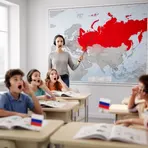
The main language of Russia spoken in many nearby countries
Surface Forms
Morphology
The meaning is directly and transparently derived from combining 'Russian' (the named language or nationality adjective) with 'language' (a system of communication); together they straightforwardly denote the language of Russia. This composition is cross-linguistically common and follows a basic noun–noun/adjacent modifier pattern, so a B1 learner who knows both constituents will understand it.
Etymology
Russian language may come from the early people called 'Rus' who lived long ago in the lands now called Russia. So Russian language simply means the language spoken by Russians, or 'the language of Russia'.