
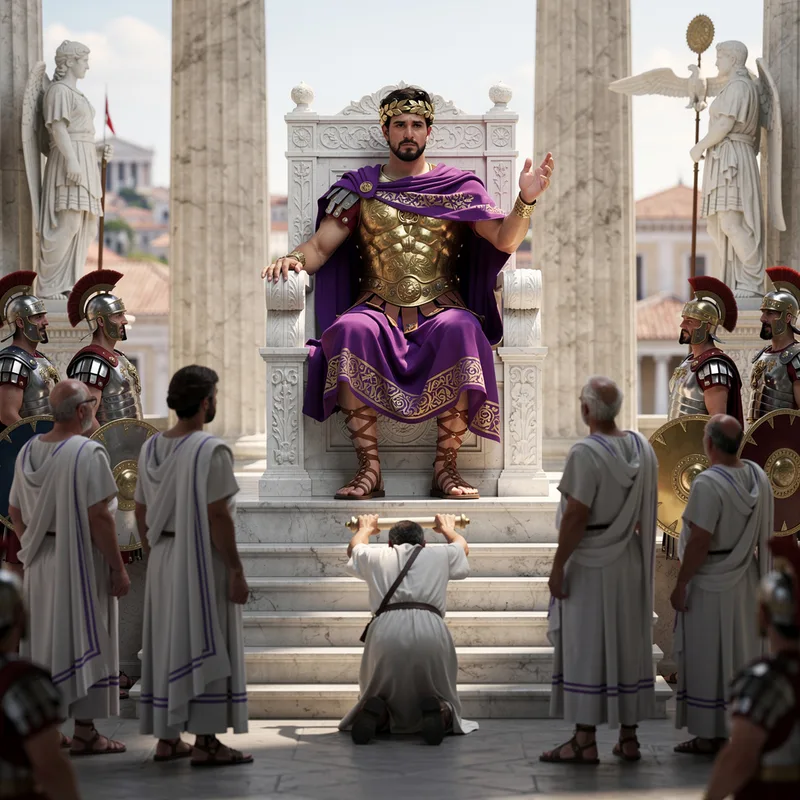
Roman Emperor
 3
5.2
3
5.2

- noun
- /ˈroʊmən ˈɛmpərər/
- The Roman emperor had absolute power over the vast territories of the ancient empire.
- the Holy Roman Emperor
- Roman Emperor built
Loading YouTube…
Watch on YouTubeBut who do you think are is the greatest Roman emperor?
- But who do you think are is the greatest Roman emperor?
- He influenced the last of the great or good Roman emperors.
- In a way, I'm going to be doing the reverse, that's to say, concentrating largely on images of Roman emperors and of their partners.
- But but the Roman emperor doesn't want to interfere for the most part locally.
- And then we have this, this book that's that's originally entitled to myself by a Roman emperor, Marcus Aurelius, who's coming a little bit later.
Examples
-
In the final years of his rule, Roman emperor Hadrian sent troops to the outer borders of England.
-
One likely possibility here is the Roman Emperor Caesar Nero.
Blog text (30) -
This man has even forbidden the people from paying taxes to the Roman Emperor!
-
I govern this land on behalf of the Roman emperor.
-
There is a truly wonderful bronze head of the first Roman Emperor, Augustus in the British Museum collection.
-
Strabo, living in the age of the first Roman emperor, had a world to describe that was different from the world of his predecessors.
Academic text (2004) -
In 313, the Roman Emperor Constantine the Great issued his Edict of Toleration, providing legal protection for Christians from persecution.
Academic text (1992) -
Roman Emperor Trajan annexed the Nabataean Kingdom in 106 CE, making it part of the Roman Province of Arabia.
Academic text (2008) -
Tripoli itself is the site of ancient Oea, now disappeared, save for the second-century A.D. arch of Roman emperor Marcus Aurelius in the medina, or old quarter.
Academic text (2002) -
Philostorgius recounts that the Roman emperor enthusiastically sent Ulfila on a mission to the Goths following his consecration by Eusebius of Nicomedia.
Academic text (2018)
Synonyms
 524
3.5
524
3.5
A man who rules an empire made of many countries
 153
2.1
153
2.1
A person who has power over a country or its people
 3
9.9
3
9.9
An old title given to a Roman general after victory


 1
6.9
1
6.9
A person who ruled the Roman Empire from Augustus to the end of the Western Empire
Surface Forms
Morphology
The meaning is directly and compositionally derived from 'Roman' (pertaining to Rome) modifying 'emperor' (a sovereign ruler), so a learner who knows both constituents will understand it refers to the ruler of the Roman Empire. This adjective+noun construction is a regular, cross-linguistic pattern and therefore readily comprehensible to B1 learners.
Etymology
The noun Roman Emperor comes from the real rulers of ancient Rome. Imagine a man in a purple robe and a crown of leaves on a throne giving orders to soldiers; the word Roman means 'from Rome' and Emperor means 'the top ruler', so together they mean 'the top ruler of the ancient Roman Empire'.