

Republic of Suriname
- proper noun
- /rɪˈpʌblɪk əv ˈsʊrɪnɑːm/
- The Republic of Suriname became independent from the Netherlands in 1975.
Examples
-
The Republic of Suriname is known for its rich biodiversity.
-
Rainforests cover much of the Republic of Suriname, making it one of South America's most biodiverse countries.
-
Dutch is the official language of the Republic of Suriname.
-
Have you ever visited the Republic of Suriname?
-
The Republic of Suriname is known for its diverse wildlife and rich cultural heritage.
-
In 1975, the Republic of Suriname achieved independence from Dutch colonial rule.
-
Suriname is a South American nation located on the Atlantic coast, officially called the Republic of Suriname.
Synonyms
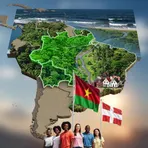
 5
5.3
5
5.3

A country in northeastern South America on the Atlantic coast that became independent from the Netherlands in 1975
 1
4.5
1
4.5
A country in northeast South America on the Atlantic coast

A former name for Suriname, a country in northeast South America

Former name for the country now called Suriname in northeastern South America when it was controlled by the Netherlands
Surface Forms
Morphology
The phrase is a compositional country name: 'republic' (a state governed by elected representatives) + 'of' + 'Suriname' (the country), so a learner who knows those words will understand it refers to Suriname as a republic. The 'Republic of [Country]' naming pattern is common cross-linguistically and follows standard noun-noun/possessive composition, making the meaning immediately inferable at B1 level.
Etymology
Republic of Suriname takes its name from the local Suriname River and the people early visitors called 'Surinen', and European settlers used that local name for the area. When the country left Dutch rule in 1975 it became a republic, an independent 'country', so the full name shows it is the independent nation of Suriname.