
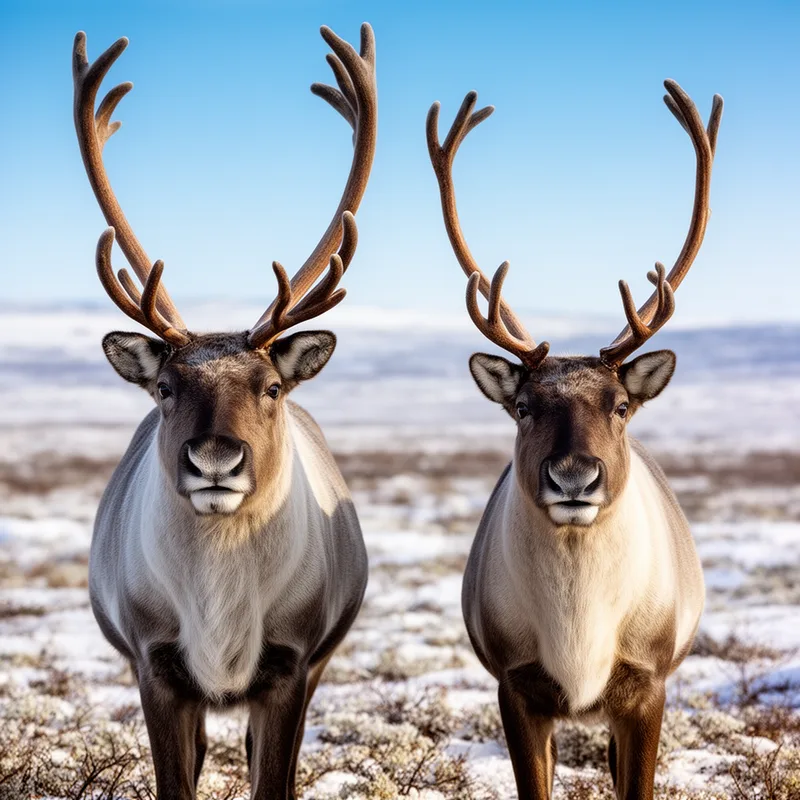
Rangifer tarandus
- noun
- /ˈræŋɪfər ˈtærændəs/
- Specialized
- Both male and female Rangifer tarandus grow large, impressive antlers each year.
Examples
-
The migration patterns of Rangifer tarandus are crucial to understanding Arctic ecosystems.
-
In North America, the Rangifer tarandus is commonly referred to as caribou.
-
Scientists studied the diet of Rangifer tarandus to assess environmental changes in the tundra.
-
The Rangifer tarandus is well adapted to cold climates.
-
Both male and female Rangifer tarandus grow large, impressive antlers each year.
-
In North America, the Rangifer tarandus is commonly referred to as caribou, especially during migration.
-
The migration patterns of Rangifer tarandus are essential for maintaining the balance of Arctic ecosystems.
Synonyms

 109
1.0
109
1.0

A large northern deer with big antlers on both males and females
 38
5.4
38
5.4
A large deer like a reindeer that lives in Arctic North America with big branched antlers
Surface Forms
Morphology
Rangifer + tarandus
This is a Latin binomial: knowing 'Rangifer' (a genus of northern deer) signals that the term names a deer species, so a learner could infer it refers to a kind of deer. However, the specific common-name meaning 'reindeer/caribou' and the exact species sense are tied to taxonomic convention rather than ordinary compositional meaning, so full understanding is not automatically predictable.
Etymology
Rangifer tarandus is a two-word Latin name given by scientists who study animals; the words Rangifer and tarandus label this Arctic deer. The name points to the animal called 'reindeer' in Europe and 'caribou' in North America, a type of deer with large antlers on both males and females. So when people use Rangifer tarandus, they mean that Arctic deer.