
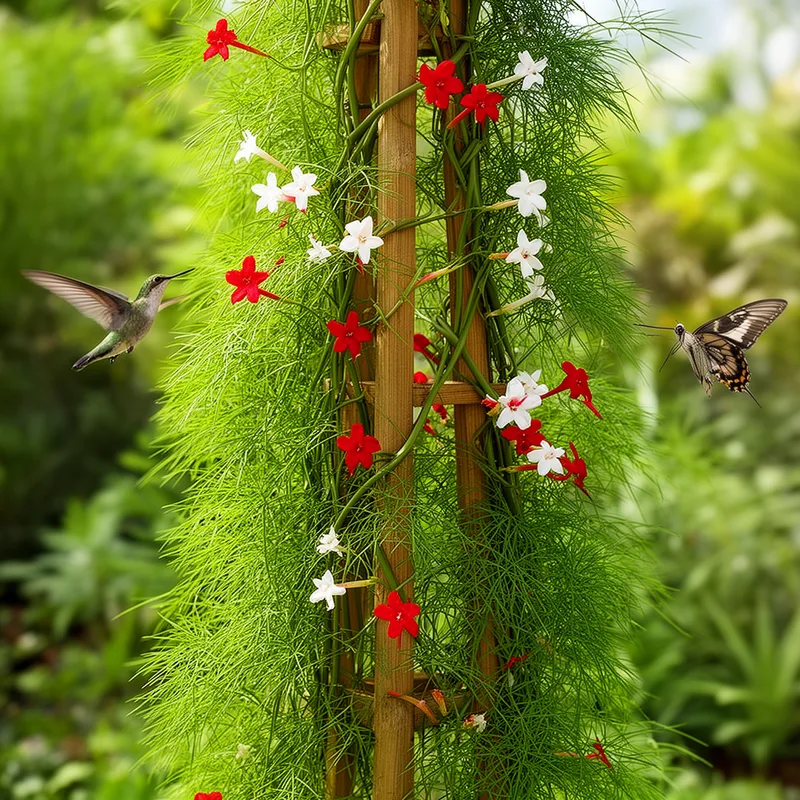
Quamoclit pennata
- noun
- Specialized
- The garden trellis was covered in the bright red blooms of Quamoclit pennata.
Examples
-
The finely dissected leaves make Quamoclit pennata a distinctive addition to any landscape.
-
Many gardeners plant Quamoclit pennata to attract hummingbirds and butterflies.
-
The Quamoclit pennata blooms beautifully in the summer.
-
I saw a Quamoclit pennata growing in my neighbor's garden.
-
Many gardeners plant Quamoclit pennata to attract hummingbirds and butterflies.
-
The finely dissected leaves make Quamoclit pennata a distinctive addition to any landscape.
-
The garden trellis was covered in the bright red blooms of Quamoclit pennata.
Synonyms
A climbing plant with thin feathery leaves and bright red tube-shaped flowers that attract hummingbirds

A climbing plant with bright red star-shaped flowers and feathery leaves
A climbing plant from tropical America with finely divided leaves and red star-shaped flowers
Surface Forms
Morphology
Quamoclit + pennata
This is a scientific Latin binomial (a species name) whose parts are not English lexical items and are listed as unknown here, so a B1 learner who knows English words would not be able to derive the plant meaning from the constituents. Botanical Latin functions as a proper name/label rather than a compositional phrase with predictable meaning, making the expression non-transparent to learners.
Etymology
The plant name Quamoclit pennata may come from an old native word for the vine and the Latin word pennata, meaning 'feathered'. The name points to the vine's very fine, feather-like leaves and the way it climbs on trellises, so you can remember it as the 'feathered' climbing plant with bright red flowers.

