

Puseyite movement
- noun
- Formal
- The Puseyite movement sought to reintroduce older rituals into Anglican worship.
Examples
-
The reforms proposed by the Puseyite movement sparked much debate within the Church of England.
-
The Puseyite movement sought to bring back ancient liturgical practices.
-
Many Victorian-era theologians were influenced by the Puseyite movement.
-
Many scholars study the Puseyite movement for its impact on Anglicanism.
-
The Puseyite movement aimed to revive the Catholic heritage within the Anglican Church.
-
In the 19th century, the Puseyite movement played a significant role in shaping Anglican worship.
-
Through its emphasis on tradition, the Puseyite movement influenced many Anglican theologians.
Synonyms

A movement in the Anglican church that returns to traditional Catholic beliefs and ritual worship

Religious beliefs and practices that Edward Pusey taught in the Oxford Movement

Religious ideas from the Oxford Movement that revive older Church of England rituals
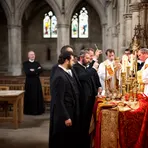
A 19th-century group in the Church of England that wanted to bring back Catholic traditions and oppose some modern changes
Surface Forms
Morphology
Puseyite + movement
The phrase combines 'Puseyite' (a name-derived label for followers of Pusey) with 'movement' (a collective group), so at a basic level a learner could infer it denotes a movement of Puseyites. However, 'Puseyite' is a low-frequency, culture- and history-specific label whose theological meaning (19th-century Anglican revivalism) is not derivable from the parts alone, so the expression is only partially transparent to a B1 learner.
Etymology
Puseyite movement is named after Edward Bouverie Pusey, a 19th-century Anglican leader whose followers wanted to bring back older 'Catholic traditions' into the 'Anglican Church'. So, the name now means a group that tried to 'revive' older church rituals.

