

Prunus domestica insititia
- noun
- Specialized
- The Prunus domestica insititia is known for producing greengages and damsons, which are popular for jams and desserts.
Examples
-
Some traditional English orchards still contain Prunus domestica insititia, valued for their diverse plum varieties.
-
Horticulturists recommend planting Prunus domestica insititia in well-drained soil for optimal fruit production.
-
The Prunus domestica insititia tree produces delicious fruit.
-
Many gardeners love to grow Prunus domestica insititia for its sweet plums.
-
Horticulturists recommend planting Prunus domestica insititia in well-drained soil for optimal fruit production.
-
The Prunus domestica insititia is known for producing greengages and damsons, which are popular for jams and desserts.
-
Many gardeners love to grow Prunus domestica insititia for its sweet plums.
Synonyms

A small plum tree that makes tart fruit called damsons used for jam
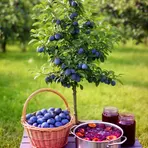
A small plum tree that produces tart fruit for jam

A small dark purple plum or the tree that grows it with a tart taste often used for jam
Surface Forms
Morphology
Prunus + domestica + insititia
This is a Latin botanical name: 'Prunus' signals the genus (plums) and 'domestica' suggests a domestic/cultivated form, so a learner who recognises those parts can infer it refers to a cultivated plum. However, the epithet 'insititia' is not transparent or listed and the trinomial denotes a subspecies-level distinction that requires specialist/botanical knowledge, so the full specific meaning is not immediately predictable to a B1 learner.
Etymology
Prunus domestica insititia is a Latin name that gives a simple picture: Prunus means 'plum', domestica means 'of the home', and insititia suggests 'grafted in' or planted in gardens. So the name shows it is a cultivated garden plum tree, the kind that gives greengages and damsons used for jam and desserts.

