
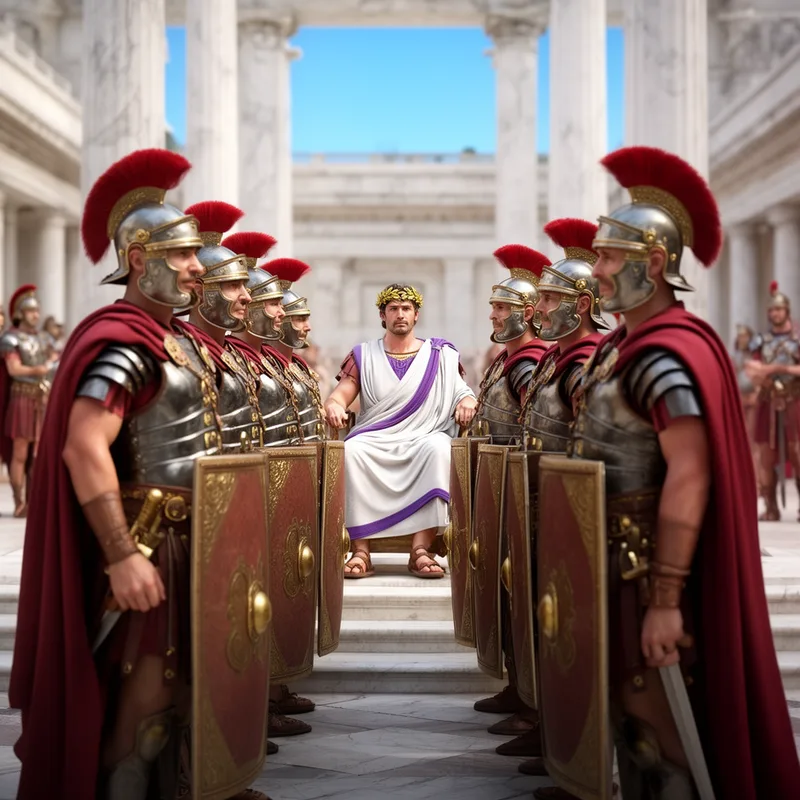
Praetorian Guard
- noun
- /ˌpriːtɔːriən ɡɑrd/
- I would do so gladly, Nero... ...but I am head of the Praetorian Guard and the Praetorians love me.
Loading YouTube…
Watch on YouTubeThey're assassinated by the Praetorian Guard, that is, by their own troops.
- They're assassinated by the Praetorian Guard, that is, by their own troops.
- Now let us take a closer look at the soldiers who made-up the ranks of this Praetorian Guard.
Examples
-
Every emperor stakes his life on the loyalty of the Praetorian Guards.
-
Captain Flavius, Praetorian Guard, salutes you.
-
Where are the Praetorian Guard?
-
Do you hear him threaten me with the Praetorian Guard?
-
I'm the sub-commander of the Praetorian Guard.
-
Every emperor relied on the loyalty of the Praetorian Guard for protection and support.
-
The Praetorian Guard was known for its elite training and dedication to safeguarding the emperor.
-
As the commander of the Praetorian Guard, he took his role in protecting the emperor very seriously.
Synonyms

 179
1.0
179
1.0

A time when someone watches and protects a place or people
 63
3.3
63
3.3
A group of people who go with and protect an important person from danger
How Expendable
46
6.7

- Offensive
7
8.5
29
4.3
8
5.9
Surface Forms
Morphology
The literal constituents ('Praetorian' = elite Roman imperial guard, + 'guard' = protective force) clearly signal an elite protective group, so a learner could infer a connection to a leader's protectors. However, the phrase's modern figurative use to mean a leader's loyal inner circle of advisers who wield political influence is a culturally specific, metaphorical extension of the historical referent and is not fully predictable from the parts alone.
Etymology
Praetorian Guard comes from ancient Rome, where it named the special group of guards who stood close to the emperor to 'protect' him. Because these guards could help or remove an emperor, their loyalty often decided who would rule.