
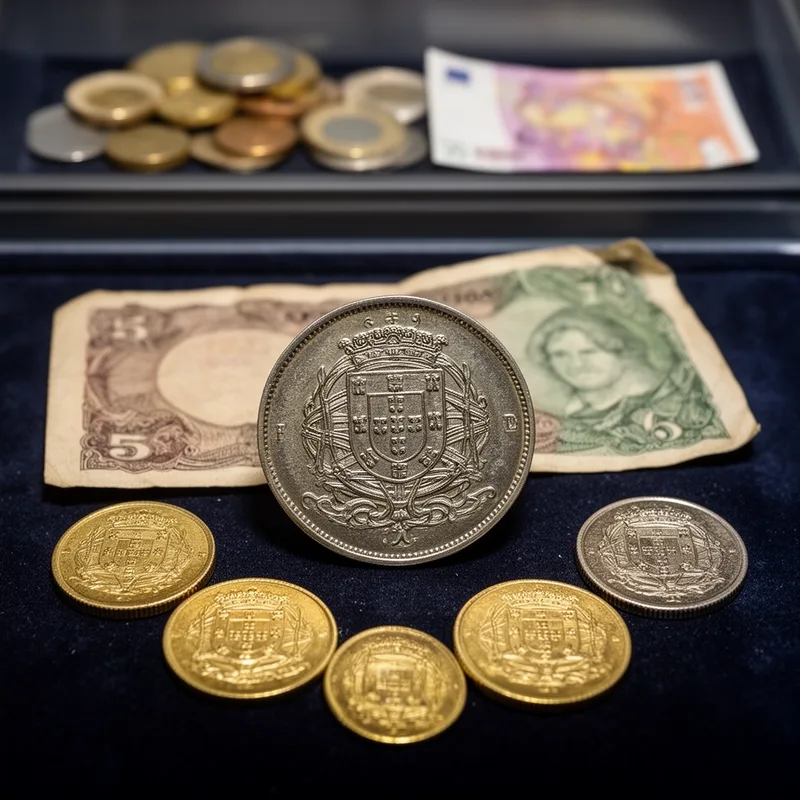
Portuguese escudo
- noun
- Literature
- Tourists exchanging their money might have received Portuguese escudos from local banks before the currency change.
Examples
-
In the 1990s, the Portuguese escudo was the main currency used for shopping in Lisbon's markets.
-
Italy and Britain left the European Monetary System without committing themselves to a return date; all three currencies, as well as the Portuguese escudo, were officially devalued.
Academic text (1993) -
Before the euro was introduced, people in Portugal used the Portuguese escudo for everyday transactions.
Synonyms


 1
9.9
1
9.9
A former Portuguese unit of money equal to 100 centavos used before the euro
Surface Forms
Morphology
The phrase is a straightforward adjective + noun composition: 'Portuguese' (denoting origin) modifies 'escudo' (a unit of currency), yielding 'the currency of Portugal'. This is non-idiomatic and follows common cross-linguistic patterns, so a B1 learner who knows both constituents can infer the meaning.
Etymology
Portuguese escudo comes from the word escudo, which means 'shield' in Portuguese. Old Portuguese coins often had a shield on them, so people began to call the coin a 'shield', and the name stuck as the country's former unit of money.