

Platonic solid


 1
9.0
1
9.0
- noun
- /pləˈtɒnɪk ˈsɒlɪd/
- Specialized
- And it's based on just a few fundamental patterns that our ancestors called the Platonic solids, for example.
Loading YouTube…
Watch on YouTubeSo not to be all correction, but isn't that a three-dimensional platonic solid?
- So not to be all correction, but isn't that a three-dimensional platonic solid?
- And it's based on just a few fundamental patterns that our ancestors called the Platonic solids, for example.
- Where Kepler Pez, he's a mathematician and he's, he knows that geometry is beautiful and perfect and there's certain number of Platonic solids.
Examples
-
The usual pentagonal dodecahedron is one of the five Platonic solids.
Blog text (8) -
The icosahedron (ICO) is one of the five Platonic solids.
Blog text (8) -
The cube is one of the five Platonic solids.
Blog text (8) -
And the the Platonic solids are the five regular polyhedra.
-
And of these, these beautiful Platonic solids that were discovered by the griefs, either are the most regular of the solid figures.
-
We would start out painting the Platonic solids, and then Elizabeth Murray would make some changes with a brush or a knife.
Blog text (28) -
Each Platonic solid can be circumscribed by a sphere, and if such spheres separate the orbits of the planets, then there can be only six planets.
Blog text (25) -
With 20 triangular sides, the icosahedron has twofold, threefold, and fivefold symmetry and the largest volume-to-surface ratio of the Platonic solids.
Academic text (2004) -
A cube and a tetrahedron are examples of Platonic solids that have faces made of congruent regular polygons.
-
The five Platonic solids are unique in that they are the only convex regular polyhedra.
Synonyms

A solid with the same flat faces and equal angles, like a cube
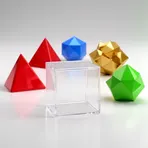
A solid with the same flat faces that are regular polygons and with all angles the same

A solid shape with identical flat faces that are regular polygons like a cube

A three-dimensional shape whose faces are the same flat shapes with all sides equal and equal angles between them

A three-dimensional shape with identical regular flat faces, like a cube
Surface Forms
Morphology
Knowing 'Platonic' (related to Plato's ideal forms) and 'solid' (a three-dimensional shape) allows a learner to infer that a 'Platonic solid' is an ideal or perfectly regular solid, so the basic concept is partially derivable. However, the term denotes a specific mathematical class (the five regular convex polyhedra) that requires technical knowledge beyond simple composition, so the meaning is not fully predictable from the parts.
Etymology
Platonic solid gets its name from the ancient Greek thinker Plato, who liked five very regular three-dimensional shapes and linked each one to a different 'element'. So Platonic refers to Plato and solid means a three-dimensional shape, and today a Platonic solid means one of those five special regular shapes.