
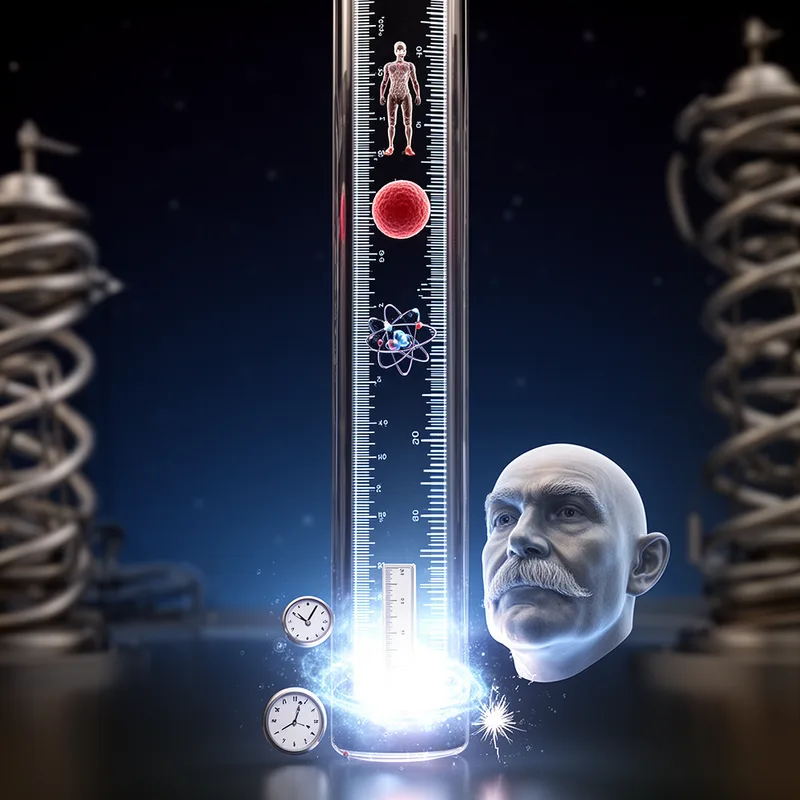
Planckian


 1
9.9
- adjective
- /ˈplæŋkiən/
- Specialized
- At Planckian scales, the usual laws of physics may no longer apply.
Examples
-
Scientists study Planckian phenomena to understand the earliest moments of the universe.
-
Researchers are investigating Planckian lengths to explain the behavior of particles at extremely small distances.
-
The experiment achieved Planckian temperatures, pushing the boundaries of modern physics.
-
The concept of Planckian scales is fundamental in quantum physics.
-
Scientists study Planckian phenomena to understand the universe's smallest structures.
-
At Planckian scales, new theories in quantum gravity are being developed.
-
The discovery of Planckian time has revolutionized our understanding of the beginnings of the universe.
Surface Forms
Morphology
Etymology
Planckian comes from the name Planck, after Max Planck who set tiny natural units such as Planck length and Planck time to measure the smallest parts of nature. So, Planckian means 'relating to those very small scales' where the usual laws of physics may need new ideas.