
Planck
 9
8.9

- proper noun
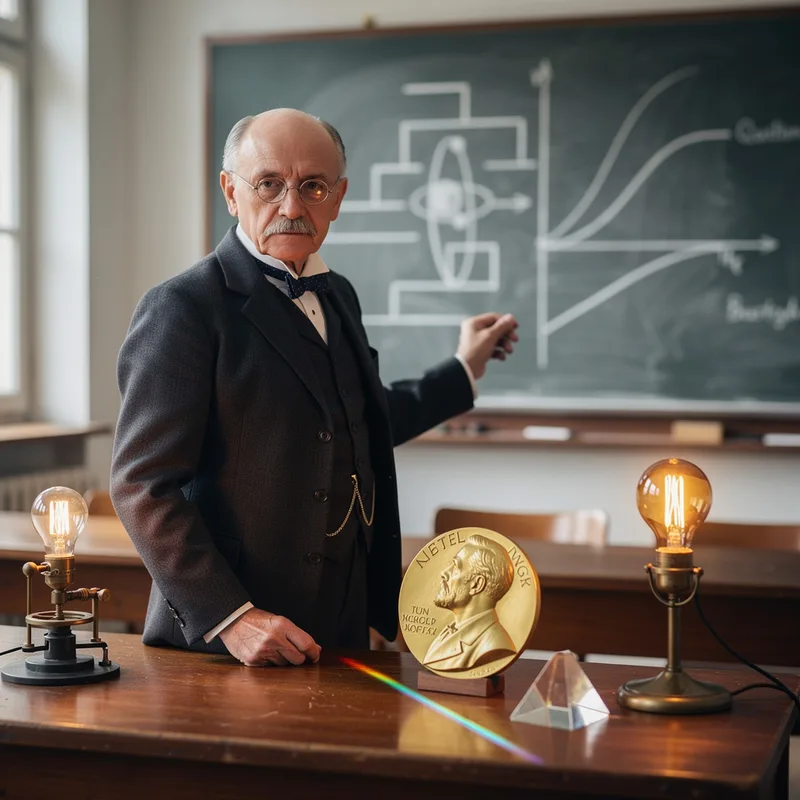
- The most important constant among them was promulgated in 1900 by the German physicist Max Planck.
- Max Planck
- physicist Max Planck
- Planck Institute
Loading YouTube…
Watch on YouTubeAnd that was known already due to the work of Planck and others, black body equilibrium.
- And that was known already due to the work of Planck and others, black body equilibrium.
- So, so Planck thought, OK, how can I fix this equation?
- And actually, there's a very famous letter of reference that Planck wrote for Einstein years later.
- So I would say, you know, did Schrodinger and Max Planck have anything to say about spirituality?
- He's a good example because Planck discovered the quantum principle that that energy levels are not continuous, but they come in certain, only certain steps.
Examples
-
The physicist Planck is best known for introducing the concept of quantized energy levels.
-
The German theoretical physicist Max Planck made the first key discovery in 1900.
Academic text (2006) -
And that was known already due to the work of Planck and others, black body equilibrium.
-
Then I moved to work for a couple of years at the Max Planck Institute in Goettingen in Germany.
-
Did you ever hear of Planck, who discovered the quantum theory in 1895?
-
1900: Max Planck proposes quantum theory of energy.
Academic text (2011) -
We are now developing a formalism of 3D quantum space based on Planck's work.
Blog text (31) -
And in quantum mechanics, the energy of a particle is proportional to Planck's constant times its wavelength.
-
Max Planck received the Nobel Prize in Physics in 1918 for his groundbreaking work in quantum theory.
-
The research conducted at the Max Planck Institute has significantly advanced our understanding of quantum mechanics.
Synonyms
 4
6.8
German scientist who started quantum theory and changed modern physics
Surface Forms
Etymology
Planck is the family name of Max Planck, a German scientist who began 'quantum theory', the study of very small particles. That's why Planck usually means this scientist in physics.