
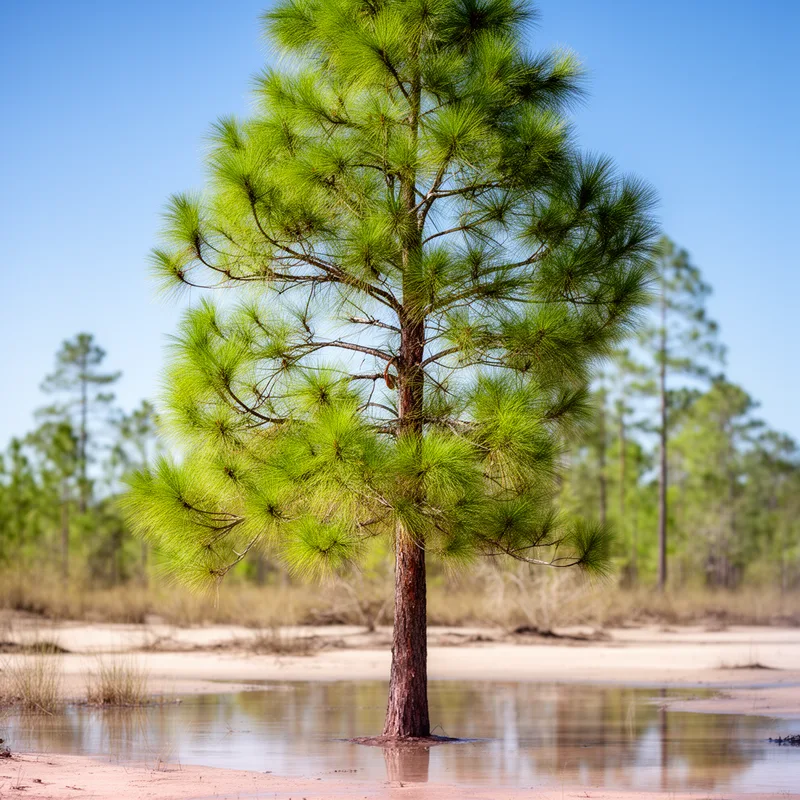
Pinus serotina
- noun
- Specialized
- The Pinus serotina thrives in wet, sandy soils.
Examples
-
Ecologists are studying how Pinus serotina adapts to periodic wildfires in its native habitat.
-
Many birds nest in the branches of Pinus serotina.
-
Due to its resilience, some landowners plant Pinus serotina for reforestation in swampy areas.
-
The Pinus serotina thrives in the wet, sandy soils of coastal Carolina.
-
Landscapers often choose Pinus serotina for its ability to grow well in sandy, wet areas.
-
The tall and resilient Pinus serotina is a common sight in the swamps of the southeastern United States.
-
In the southeastern U.S., Pinus serotina provides habitat for various wildlife species in its swampy environment.
Synonyms

A large tree with long needles that grows in wet sandy areas of the southeastern United States
How Big


Surface Forms
Morphology
A learner who knows 'Pinus' (the pine genus) and that 'serotina' is a specific epithet will be able to infer that this is a species of pine, so part of the meaning is directly compositional. However, the binomial is essentially a conventional scientific label and does not convey species-specific attributes (e.g., 'pond pine', habitat, needle count) to a B1 learner, so the full meaning is not predictable from the constituents.
Etymology
Pinus serotina gets its name from the Latin word serotina, which means 'late', and from the common name 'pond pine' because it grows in wet, sandy places. Its cones often stay closed and only open after a fire or strong heat, so the seeds are released 'late', which explains the name.