
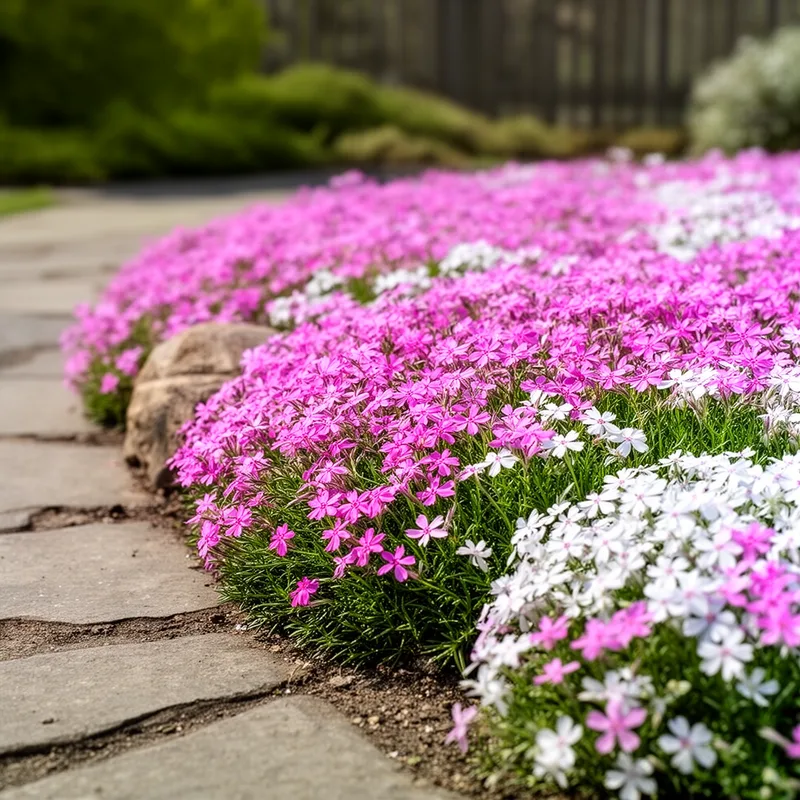
Phlox subulata
- noun
- Specialized
- The garden was filled with beautiful Phlox subulata this spring.
Examples
-
Gardeners often choose Phlox subulata for rock gardens because of its dense, mat-forming growth.
-
In early spring, the Phlox subulata bursts into a vibrant carpet of flowers in our garden.
-
We planted Phlox subulata along the walkway to create a colorful and hardy ground cover.
-
Many landscapers recommend Phlox subulata for ground cover.
-
In the spring, the garden was filled with vibrant clusters of Phlox subulata blooming in shades of pink and white.
-
For a beautiful ground cover, many gardeners choose Phlox subulata due to its lush foliage and attractive flowers.
-
The low-growing Phlox subulata adds a colorful touch to the landscape, thriving in sunny areas.
Synonyms

A low plant with pink or white flowers that spreads to cover the ground

A low, spreading plant with thin needle leaves and pink or white flowers used to cover the ground

A low, spreading evergreen plant with small pink or white flowers used to cover the ground
A low plant with thin, green leaves and pink or white flowers used as a ground cover
Surface Forms
Morphology
phlox + subulata
This is a Latin binomial (taxonomic) name: 'Phlox' indicates a plant genus but the epithet 'subulata' is a Latin/technical label rather than a meaningful English word, so the specific sense ('low, tufted perennial with needlelike leaves') is not derivable from the parts. Binomial names function as arbitrary labels across languages, so a B1 learner who knows the constituent forms would not be able to infer the botanical description.
Etymology
The name Phlox subulata comes from older words: Phlox means 'flame' because its flowers look bright and subulata means 'needle-shaped' because its leaves are thin and pointy. So the name helps you remember it as a low plant that makes a carpet of bright, flame-like flowers and has needle-shaped leaves.

