
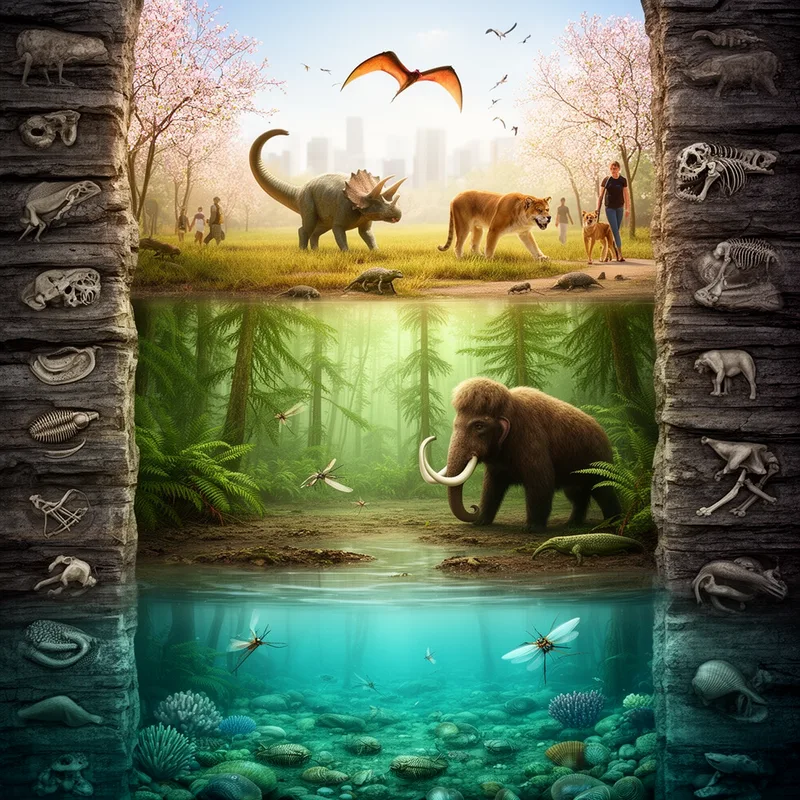
Phanerozoic eon
- noun
- /ˌfænəroʊˈzoʊɪk ˈiːɒn/
- Specialized
- The Phanerozoic eon includes well-known periods such as the Paleozoic, Mesozoic, and Cenozoic.
Examples
-
Life on Earth became abundant and complex during the Phanerozoic eon.
-
The Phanerozoic eon began approximately 540 million years ago.
-
Fossils found in the Phanerozoic eon display the remarkable diversity of ancient life.
-
During the Phanerozoic eon, life diversified significantly.
-
The Phanerozoic eon is characterized by the presence of diverse life forms throughout its history.
-
During the Phanerozoic eon, many significant evolutionary events occurred, including the emergence of mammals.
-
Scientists study the fossils from the Phanerozoic eon to understand the evolution of life on Earth.
Synonyms

A long period of Earth's history starting about 540 million years ago when many animals and plants appear
Surface Forms
Morphology
The phrase is simply a proper-name modifier plus the noun for a geological time unit: 'Phanerozoic' specifies which eon and 'eon' denotes the long geological time period. Given knowledge of both constituents (especially that 'Phanerozoic' names the eon starting ~540 million years ago), the overall meaning is directly derivable and not idiomatic.
Etymology
Phanerozoic eon comes from Greek words: phanero- meaning 'visible', -zoic meaning 'life', and eon meaning 'age'. So, the name paints a clear picture of an 'age of visible life', which is why it refers to the long time from about 540 million years ago to today when many animals and plants became common.

