
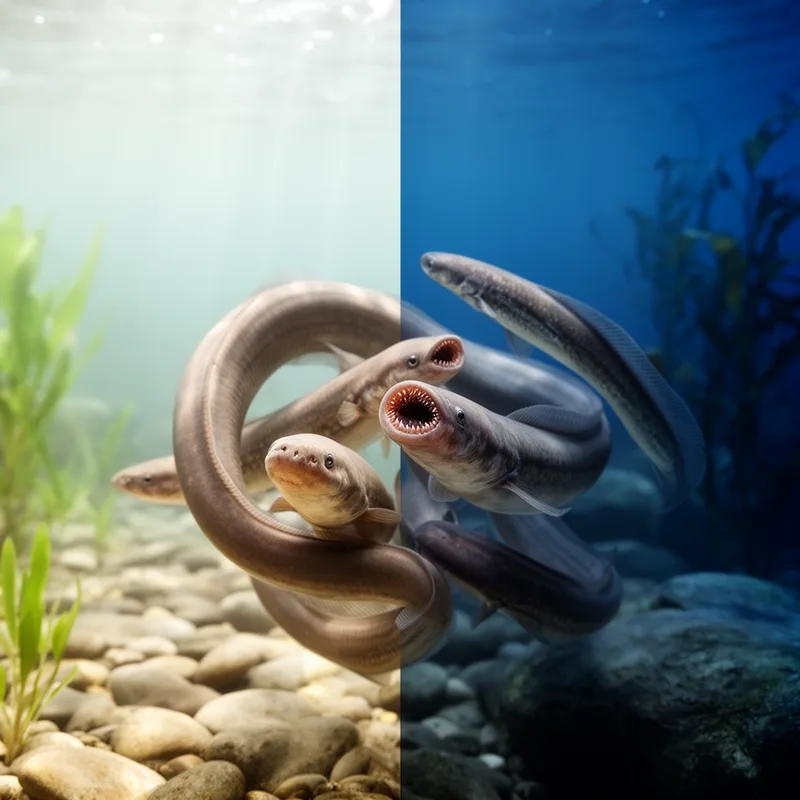
Petromyzoniformes
- noun
- /ˌpɛtrəˌmaɪzənɪˈfɔrmiːz/
- Specialized
- The order Petromyzoniformes includes all lampreys found in freshwater and marine environments.
Examples
-
Unlike hagfishes, Petromyzoniformes possess a well-developed dorsal fin.
-
Scientists often study Petromyzoniformes to understand the evolution of vertebrates.
-
The Petromyzoniformes are fascinating creatures of the ocean.
-
Did you know that Petromyzoniformes have no jaws?
-
The order Petromyzoniformes is characterized by their unique lifecycle and bloodsucking habits.
-
Researchers are interested in Petromyzoniformes for insights into jawless fish evolution.
-
Many species within Petromyzoniformes are known for their parasitic behavior on other fish.
Synonyms
 9
9.0
9
9.0

A thin eel-like fish with no jaws that attaches to other fish to feed
A long fish without jaws with a round mouth that sucks blood from fish in rivers or seas
Compounds
- Specialized
A group of jawless fish that includes lampreys with round sucking mouths
Surface Forms
Morphology
Petromyzoniformes = Petromyzon (opaque) = Petromyzon + iformes
This is a scientific taxonomic formation built from the genus name Petromyzon plus the order-forming suffix -iformes, but the resulting class name is not inferable for most learners.
Etymology
Petromyzoniformes breaks into Greek parts petro 'rock' and myzon 'to suck', while the ending -iformes marks a group of animals. So the name can be remembered as 'rock-suckers', which fits lampreys because of their round, sucking mouth and the way they cling to surfaces or hosts.