
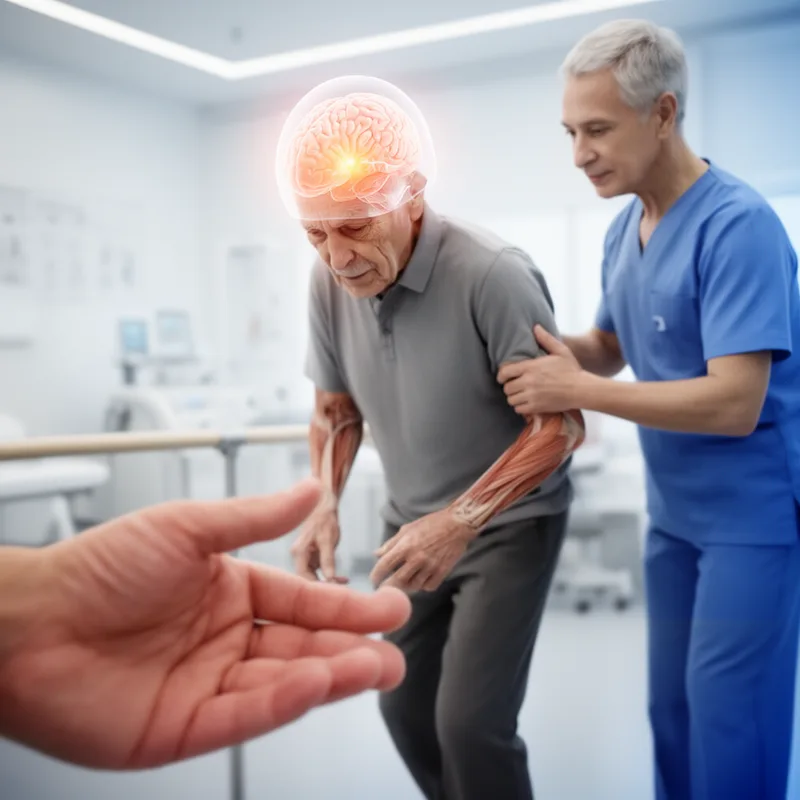
Parkinsonism
 1
7.7
1
7.7

- noun
- /ˌpɑrkɪnˈsənɪzəm/
- Specialized
- The doctor explained that Parkinsonism can significantly impact coordination and balance.
- diseases like Parkinsonism
Loading YouTube…
Watch on YouTubeBut to say that he doesn't have Parkinsonism is simply fat, actually falls.
- But to say that he doesn't have Parkinsonism is simply fat, actually falls.
Examples
-
His legs have become weak due to Parkinsonism, making it difficult for him to walk.
-
Neurological conditions such as myasthenia gravis, parkinsonism, and motor neurone disease can produce changes in voice, but usually as part of more widespread problems, such as with swallowing.
Academic text (2011) -
But to say that he doesn't have Parkinsonism is simply fat, actually falls.
-
But to say that he doesn't have Parkinsonism is simply fat, actually false.
-
All subjects had parkinsonism.
Academic text (1991) -
Other conditions causing progressive nervous system degeneration, such as Lewy body dementia, can also cause parkinsonism, as they can damage the basal ganglia.
Academic text (2011) -
He guessed that it was because of the memories that they evoked of his father's decline into parkinsonism, shuffling like they did and appearing vague.
Fiction book (1998) -
Professional and professorial types filing past a placard, an enlargement of an article from the Journal of Neurochemistry titled: LEVADOPA IN THE TREATMENT OF PARKINSONISM.
Fiction book (1990) -
The relation has a head, a tail, and a predicate; for instance, in medicine, we may say that "Parkinson's causes resting tremor" or "Parkinson's matches Parkinsonism."
Academic text (2017) -
After years of research in murine and human cancer cells as in vitro models to dissect molecular pathways of Parkinsonism, the use of human fibroblasts from patients and appropriate controls as ex vivo models has become a valuable research tool, if potential caveats are considered.
Blog text (4)
Synonyms
 19
3.1
19
3.1
A long-term brain illness that causes shaking, stiff muscles, and slow movement

A long-term brain disease that causes shaking, stiff muscles and slow movement

A brain disease that causes shaking, stiff muscles, and slow movement
A brain disease that gets worse and causes tremors, stiffness, and slow movement

A long-term brain illness that causes shaking and stiff muscles
Surface Forms
Morphology
Parkinsonism = Parkinson (semi-transparent) = Parkinson + ism
The formation 'Parkinson' + '-ism' clearly denotes a medical condition related to Parkinson's disease, but as an eponymous specialist term it may not be immediately obvious to general learners.
Etymology
Parkinsonism comes from the name of the doctor Parkinson and the ending -ism, which means a 'condition' or 'state'. So Parkinsonism is a condition that looks like Parkinson's disease, with tremors, stiffness and problems with movement.