
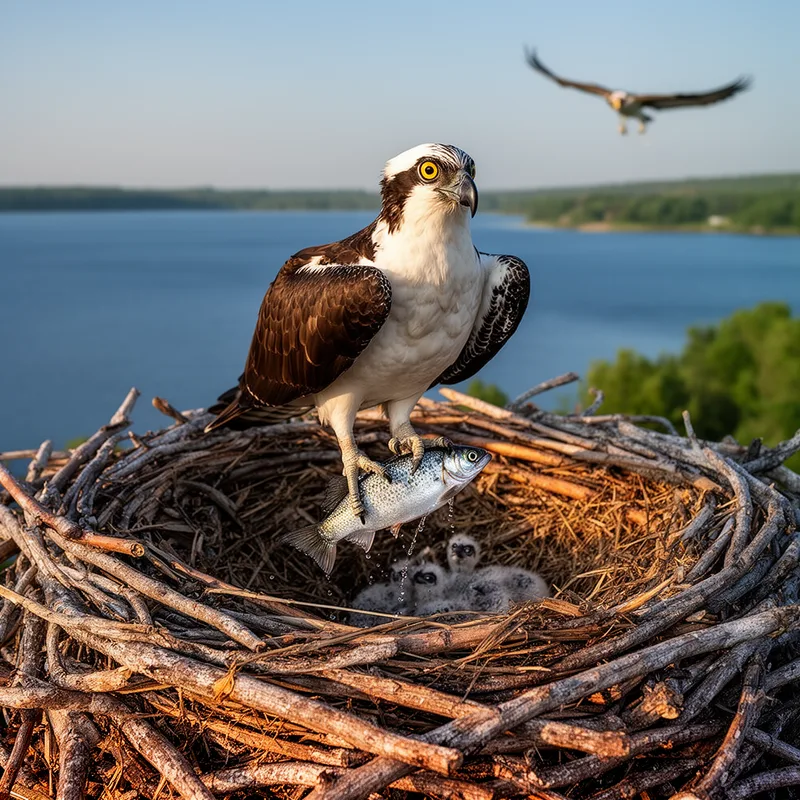
Pandion haliaetus
- noun
- /ˈpændiən hɑːliˈeɪtəs/
- Specialized
- The Pandion haliaetus can often be seen hovering over lakes and rivers in search of fish.
Examples
-
Many conservation programs focus on protecting the nesting sites of Pandion haliaetus.
-
Did you know that the Pandion haliaetus can dive at high speeds?
-
A detailed study of the migration patterns of Pandion haliaetus was published last year.
-
The Pandion haliaetus is often seen near large bodies of water.
-
The Pandion haliaetus builds large nests made of sticks and other materials in tall trees.
-
You can often spot a Pandion haliaetus near the shoreline, ready to catch fish with its sharp talons.
-
Many birdwatchers travel to observe the Pandion haliaetus during its nesting season in the spring.
Synonyms

 11
6.7
11
6.7

A large bird that dives to catch fish near rivers and lakes

 1
4.9
1
4.9
A large hawk that catches fish, for example an osprey
A large bird that hunts fish near the sea

A large bird that catches fish and often builds big nests near water
Surface Forms
Morphology
Pandion + haliaetus
This is a Latin scientific name (a taxonomic binomial) and not a compositional English phrase; the constituents are proper names/roots rather than common English words (one element is not even found in the dictionary). Even if the roots historically mean something like 'sea' + 'eagle,' that etymological knowledge is specialized and not accessible to an average B1 learner, so the overall meaning 'osprey' cannot be derived from the parts.
Etymology
Pandion haliaetus may come from an old Greek story about a hero called Pandion and the Greek word haliaetus, which means 'sea eagle'. That picture of a bird hunting fish over water explains the name, because the osprey is a 'fish-eating bird' that lives in big nests by lakes and rivers.