

Paleozoic
 1
9.9
1
9.9

- adjective
- /ˌpeɪliəˈzoʊɪk/
- Specialized
- The Earth has survived 4.5 billion years; nature will survive the coming sixth extinction, which we will have wrought, albeit with species that seem as alien to us now as those abundant in the Paleozoic era.
- Paleozoic era
- end of the Paleozoic
Examples
-
The Paleozoic rock sequences from Cambrian to Permian age are exposed in the walls of the Grand Canyon, Marble Canyon, and Little Colorado River Gorge.
Blog text (1) -
"It's an estuarine fish—the Paleozoic equivalent of catfish."
Fiction book (2002) -
Their voices were the only sounds under the black, starshot Paleozoic sky; the exchange was jarring.
Fiction book (2002) -
Or that one of those ugly little fish isn't the Paleozoic equivalent of fugu.
Fiction book (2002) -
Most abundant were trilobites, members of the family of scuttling, many-legged invertebrates with crusty outer skeletons that thrived during much of the Paleozoic era.
Academic text (1992) -
As a way of studying Earth's past and of learning about the climate and environment in the Silurian and Devonian periods of the Paleozoic Era, Kevin Swain searched through layers of shale in three areas around Rochester, New York.
Academic text (2001) -
The fossilized remains of fish are often found in Paleozoic layers of rock.
-
During the Paleozoic period, many marine and terrestrial species began to diversify rapidly.
-
Paleozoic geology reveals important insights into early animal evolution and Earth's history.
Compounds
- Specialized
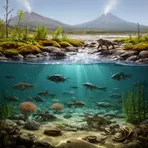
A long time in Earth's past when many new animals and plants first appear
Surface Forms
Morphology
Etymology
Paleozoic comes from Greek parts paleo- ('old') and -zoic ('life'), with the same 'zo-' as in zoo or zoology. So it means 'old life', and we use it to describe rocks, fossils, or events that belong to that ancient era.