
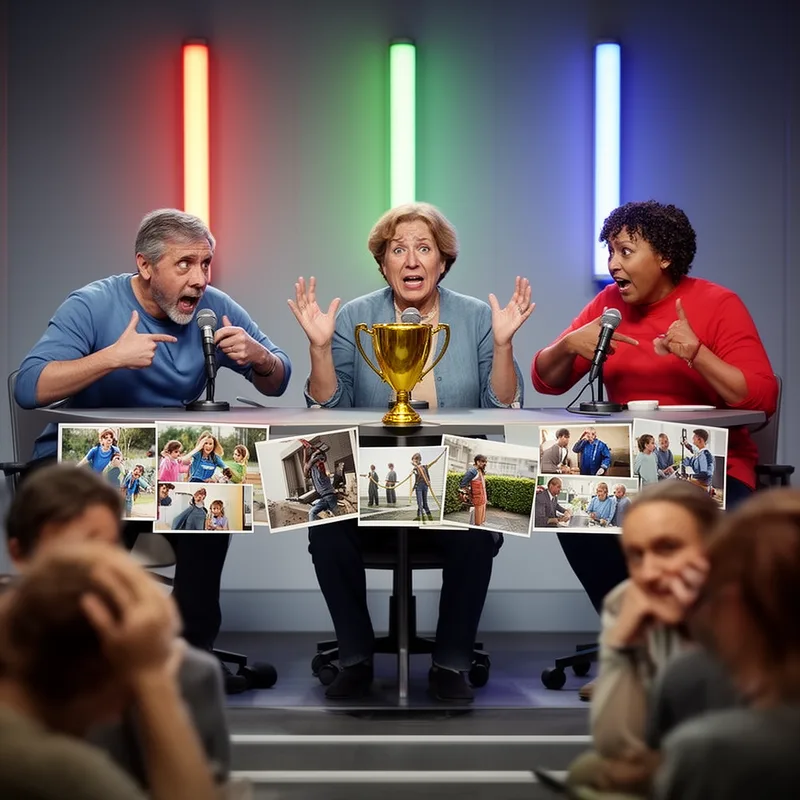
Oppression Olympics
- noun
- Offensive
- The debate often turns into an Oppression Olympics, where individuals compete to prove their suffering.
Loading YouTube…
Watch on YouTubeWhy is identity politics and this sort of oppression Olympics so viral?
- Why is identity politics and this sort of oppression Olympics so viral?
- It's kind of like it's not the oppression Olympics.
Examples
-
Why is identity politics and this sort of oppression Olympics so viral?
-
There is a, like an oppression Olympics that black people and Jews are fighting.
-
And even if you could win the Oppression Olympics?
Blog text (15) -
That there is a, like an oppression Olympics that black people and Jews are fighting.
-
Why is identity politics and this sort of oppression Olympics so viral?
-
Critics argue that engaging in Oppression Olympics distracts from the real issues of inequality and injustice.
-
In online discussions, the Oppression Olympics can lead to harmful divisions instead of promoting understanding.
Synonyms
An event where people focus on social justice causes more than art or sport
Surface Forms
Morphology
oppression + Olympics
The phrase combines the literal meanings of 'oppression' (suffering or unjust control) and 'Olympics' (a competitive sporting event) to create a metaphor of competing over who has experienced more oppression. A B1 learner who knows both words can likely infer the basic idea of a competition about oppression, but the ironic, rhetorical and sociopolitical nuance (that it criticizes comparative victimhood) is not fully predictable without cultural exposure. This partial predictability makes the expression semi-transparent.
Etymology
Oppression Olympics comes from a strong picture: imagine the Olympics but instead of sports people compare their oppression, turning suffering into a 'competition'. That's why today the phrase means arguing to prove who has suffered more rather than working together.

