

Old World vulture
- noun
- /oʊld wɜrld ˈvʌltʃər/
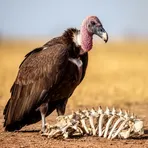
- Unlike its American counterpart, the Old World vulture relies mainly on sight to find food.
Examples
-
The Old World vulture is adapted to soaring over open plains in search of carcasses.
-
Many Old World vultures feed on carrion.
-
Several species of Old World vulture are now considered endangered due to habitat loss and poisoning.
-
The Old World vulture is known for its impressive wingspan.
-
The Old World vulture circles high above the savannah, searching for food.
-
In Africa, the Old World vulture plays a crucial role in the ecosystem by cleaning up carcasses.
-
Tom spotted an Old World vulture perched on a tree branch, watching for any movement below.
Synonyms
 42
3.3
42
3.3

A large bird with a bare head that eats dead animals

A group of large vultures from Europe, Africa, and Asia that eat dead animals
Surface Forms
Morphology
The noun 'vulture' is fully transparent, but the modifier 'Old World' is a conventional geographic term meaning Eurasia/Africa (as opposed to 'New World') rather than a literal 'ancient world'. A B1 learner who only knows the basic senses of 'old' and 'world' may not infer this regional classification, so the phrase is partially compositional but requires prior lexical knowledge of the set phrase.
Etymology
Old World vulture gets its name from the old label 'Old World' for Europe, Asia and Africa, a simple way early explorers and scientists used to show where a bird came from. So, the name means a vulture from those 'old' continents, not the different 'New World' vultures of the Americas.