
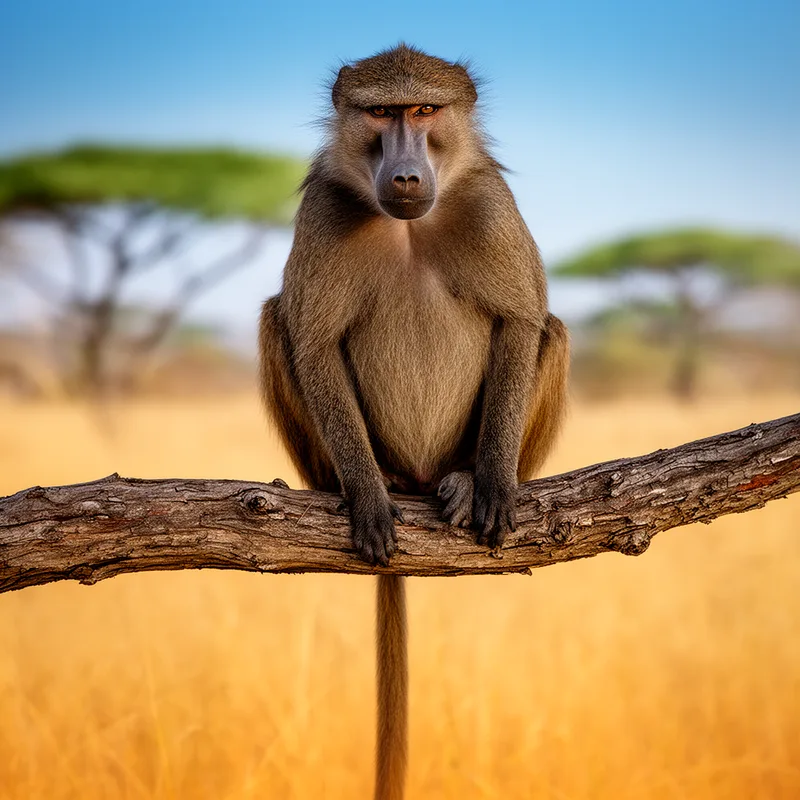
Old World monkey
- noun
- /oʊld wɜrld ˈmʌŋki/
- Indian
- Humans, great apes, and Old World monkeys have three opsins, which provide full color vision across the spectrum, from violet through blue, green, and yellow, and on to red.
- Old World monkeys and apes
Examples
-
Humans and chimpanzees, for example, seem to have shared a common ancestor only 5 million years ago, while the common ancestor of Old World monkeys and humans lived roughly 20 million years ago.
Academic text (1990) -
This distinguishes them from the modern monkeys, which also evolved from the primate stock present prior to the separation of apes from Old World monkeys.
Academic text (1995) -
In these pictures the the old world monkey, the greenon is is most similar to the human.
-
However, ape diversity was even then declining as the so-called Old World monkeys moved into their habitat and successfully competed with them.
Academic text (1995) -
The Proboscis Monkey is an endangered reddish-brown Old World monkey that is only found in Borneo.
Academic text (2008) -
As in other Old World monkey societies, females remain in their natal groups throughout their lives, maintaining close bonds with their matrilineal kin; males transfer to neighboring groups at sexual maturity.
Academic text (1990) -
Vervets are members of the largest family of Old World monkeys, which includes baboons, macaques, and many forest-dwelling monkeys, and they are among the most common primates in sub-Saharan Africa.
Academic text (1990) -
The Old World monkeys belonged to the family Cercopithecinae, whereas the PARV4-positive Colobus and Piliocolobus species described herein belong to the Colobinae branch of the family Cercopithecidae.
Academic text (2012) -
The Proboscis Monkey is an endangered reddish-brown Old World monkey that is only found in Borneo.
-
Monkeys, characterized by long tails and flat, hairless faces, are generally divided into two types: Old World monkeys, such as baboons and macaques, found in Asia and Africa.
Synonyms


 1
9.9
1
9.9
A family of monkeys from Africa and Asia including baboons and macaques
Surface Forms
Morphology
The phrase is compositionally built: 'Old World' (the geographic/historic region comprising Africa and Asia/Europe) modifies 'monkey', so a learner who knows 'old', 'world' and 'monkey' can infer it refers to monkeys from the Old World (i.e., Africa/Asia). This is a straightforward noun-modifier combination that is cross-linguistically common and therefore readily understandable to a B1 learner.
Etymology
Old World monkey gets its name from early European explorers and scientists who called Africa and Asia the Old World and the Americas the New World. So, because these Old World monkeys have tails that cannot grasp things and noses that are close together, the name now means 'monkeys from Africa and Asia' with those features.