
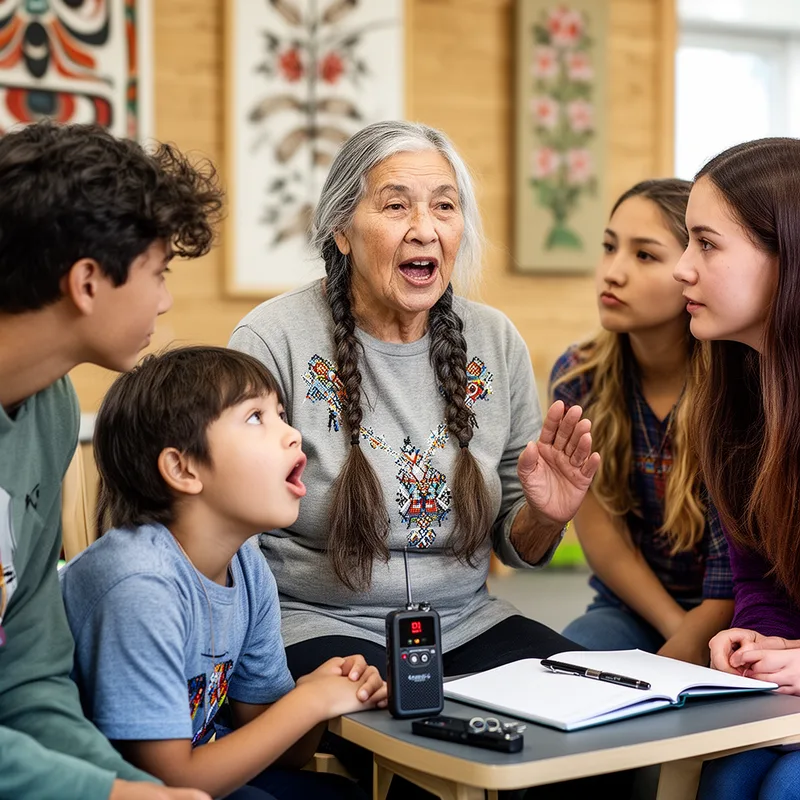
Ojibwa language


 1
9.8
- noun
- /oʊˈdʒɪb.wə ˈlæŋɡwɪdʒ/
- US
- Linguists have documented the Ojibwa language to help keep it alive for future generations.
Examples
-
The Ojibwa language has a rich oral tradition that is still preserved today.
-
Many children are learning the Ojibwa language today.
-
She is learning to speak Ojibwa language to connect with her heritage.
-
The Ojibwa language is rich in history.
-
Linguists have documented the Ojibwa language to help keep it alive for future generations.
-
She is learning to speak Ojibwa language to connect with her heritage.
-
Many children are learning the Ojibwa language today.
Synonyms
 1
9.5
A Native language spoken around Lake Superior by Ojibwe people
 1
9.9
A Native American people of the Great Lakes region who speak their own language
 1
9.9
A Native American language spoken around Lake Superior in Canada and the northern United States

A language spoken by the Ojibwa people in North America

A language spoken by the Ojibway people in parts of Canada and northern United States
Surface Forms
Morphology
This is a fully compositional noun phrase: 'Ojibwa' names the people/ethnic group and 'language' denotes a speech system, so the meaning 'the language of the Ojibwa people' is directly derivable from the parts. The proper-noun + language pattern is cross-linguistically common and would be clear to a B1 learner who knows both constituents.
Etymology
Ojibwa language comes from the people's own name Ojibwa. One popular story says Ojibwa comes from a word for a way of sewing moccasins that makes the leather 'pucker', so it meant 'people who make puckered moccasins' and later became the name of the people and their speech.