

Nicaea
 1
9.9
1
9.9

- proper noun
- /naɪˈsiːə/
- The history of the Church between the Council of Nicaea in 325 and the Council of Constantinople in 381 is illustrative.
- Council of Nicaea
- Nicaea in 325
Examples
-
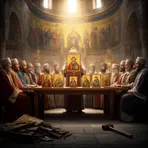
During the Council of Nicaea, over three hundred bishops gathered to resolve critical theological disputes.
-
The formulas from the councils of Nicaea and Chalcedon, and the Cappadocian Fathers' trinitarian terminology constitute the foundation of classic orthodoxy.
Academic text (2001) -
Yes, it was rejected at the Council of Nicaea along with any other gospels that made Jesus appear human and not divine.
-
Roman emperor, Constantine, changed things when he formed Christianity into a state religion through his council of Nicaea in 325.
-
And to strengthen this new Christian tradition, Constantine held a famous ecumenical gathering known as the Council of Nicaea.
-
Thus, when Emperor Constantine summoned the bishops to Nicaea, he was acting in accordance with his role as a good Christian emperor.
Academic text (2018) -
And no, the Council of Nicaea didn't establish a canon; it only established trinitarianism as the orthodoxy.
Blog text (25) -
The Council of Nicaea in 325 AD established the Nicene Creed and addressed the divinity of Jesus.
-
The first ecumenical council, known as the Council of Nicaea, played a crucial role in defining Christian orthodoxy.
Synonyms

A meeting of Christian leaders in 325 that made the Nicene Creed and declared Arianism wrong
Compounds
A meeting of Christian leaders in 325 that made the Nicene Creed and declared Arianism wrong
A church meeting in 787 that stopped destroying religious images and allowed their use in worship
Surface Forms
Etymology
Nicaea as the name of the 325 council comes from the city Nicaea, and that city name Nikaia comes from nike meaning 'victory', so the council is simply named after the place with the 'victory' name.