

First Council of Nicaea
- proper noun
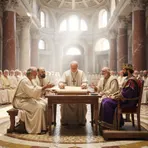
- The First Council of Nicaea, held in 325 AD, was pivotal in establishing the core beliefs of Christianity.
Examples
-
The First Council of Nicaea established the Nicene Creed.
-
The condemnation of Arianism was a major outcome of the First Council of Nicaea.
-
Many historians study the decisions made at the First Council of Nicaea to understand the development of the Church.
-
The First Council of Nicaea played a crucial role in shaping early Christian doctrine.
-
In 325 AD, the First Council of Nicaea was convened.
-
During the First Council of Nicaea, bishops from across the Christian world gathered to address key theological disputes.
-
The Nicene Creed, formulated during the First Council of Nicaea, remains a fundamental statement of faith in Christianity.
Synonyms
 1
9.9
1
9.9

The first meeting of Christian leaders in 325 AD that made the Nicene Creed
Surface Forms
Morphology
The phrase is directly compositional: 'first' (preceding), 'council' (assembly) and 'of Nicaea' (associated with the place/name Nicaea) yield the interpretation 'the first council held at Nicaea.' While detailed historical facts (325 AD, Nicene Creed, condemnation of Arianism) require extra background knowledge, the basic referential meaning is plainly derivable from the constituents and is cross-linguistically transparent.
Etymology
First Council of Nicaea was a meeting in 325 when Christian leaders gathered in the town of Nicaea to argue and write the Nicene Creed so they could agree on 'what Christians should believe'. That's why the name now stands for the first major decision that helped shape Christian belief.