
Newton's law of gravitation
- noun
- /ˈnjuːtənz lɔː ʌv ˌɡrævɪˈteɪʃən/
- Specialized
- The orbits of the planets can be explained by Newton's law of gravitation.
Examples
-
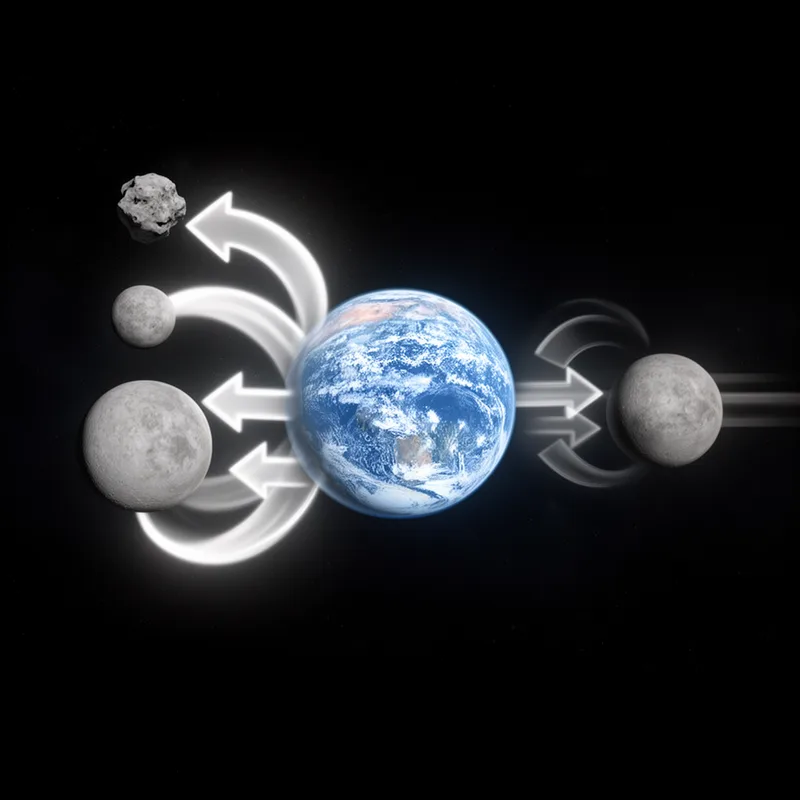
According to Newton's law of gravitation, the force decreases as the distance between the objects increases.
-
Physicists often compare Einstein's theory of relativity to Newton's law of gravitation in explaining celestial movements.
-
According to Newton's law of gravitation, every object attracts another.
-
Can you explain Newton's law of gravitation to me?
-
According to Newton's law of gravitation, the Earth and the Moon attract each other with a force that depends on their masses and the distance between them.
-
Scientists use Newton's law of gravitation to calculate the gravitational force acting between two objects in space.
-
In his studies, he explained how Newton's law of gravitation shows the relationship between mass and the force of attraction.
Synonyms

 4
3.7
4
3.7

An idea that all objects pull on each other, more when they are heavier and closer

 1
4.8
1
4.8
A scientific idea that objects with mass pull on each other more strongly when they are heavier and closer

All objects attract each other with a force that grows with mass and falls with distance

A scientific idea about how objects pull each other, with larger objects pulling more and pull weakening with distance
A scientific theory saying any two objects pull each other more if heavier and less as they get farther apart
Surface Forms
Morphology
Newton's + law + of + gravitation
The phrase is a straightforward compositional naming pattern: a proper name (Newton's) + law + gravitation, so a learner who knows those words can infer it refers to Newton's scientific rule about gravity. This is not idiomatic or metaphorical and follows a cross-linguistically common pattern of naming scientific laws, so the meaning is immediately derivable from the parts.
Etymology
Newton's law of gravitation comes from a famous story where Isaac Newton saw an apple fall and imagined the same force pulling the Moon toward the Earth. That's why the name refers to a simple rule about how objects 'pull' each other and why that pull gets weaker as they move farther apart.