

New Hebrides
- proper noun
- Literature
- Before 1980, the island group known as the New Hebrides was administered by both France and Britain.
Examples
-
The New Hebrides were named by Captain Cook during his voyage in the Pacific in the 18th century.
-
Like the Hausa, the people of Vanuatu (known as the New Hebrides until its independence in 1980) were ruled by both France and Britain.
Academic text (1993) -
Prior to European takeover, there was no overarching chieftaincy organization or association that linked different islands in the chain that became known as the New Hebrides.
Academic text (1993) -
Rather than assimilating the chiefs into their local administration throughout the New Hebrides, the French and British appointed trusted "assessors" to act as intermediaries between the islanders and the colonial authorities.
Academic text (1993) -
After gaining independence in 1980, the New Hebrides officially became known as Vanuatu.
Synonyms

 3
5.7
3
5.7

A country made of many islands in the South Pacific
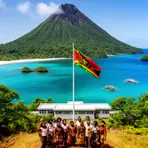
A volcanic island country in the South Pacific independent since 1980
Surface Forms
Morphology
new + Hebrides
The form 'New Hebrides' is compositional: 'new' + the place-name 'Hebrides' follows a common naming pattern (e.g. New York, New Zealand) that signals a place or island group named after the Hebrides. This construction is cross-linguistically familiar and non-idiomatic, so a B1 learner who knows the constituents would infer it refers to a (newly named) place or islands, even if they do not know the historical detail that it is now Vanuatu.
Etymology
The name New Hebrides comes from early European explorers. One popular story says Captain Cook thought the island group looked like the Scottish Hebrides, so he called them 'new' Hebrides, which is why this was the old name for the islands now called 'Vanuatu'.