
Muntingia calabura
- noun
- Specialized
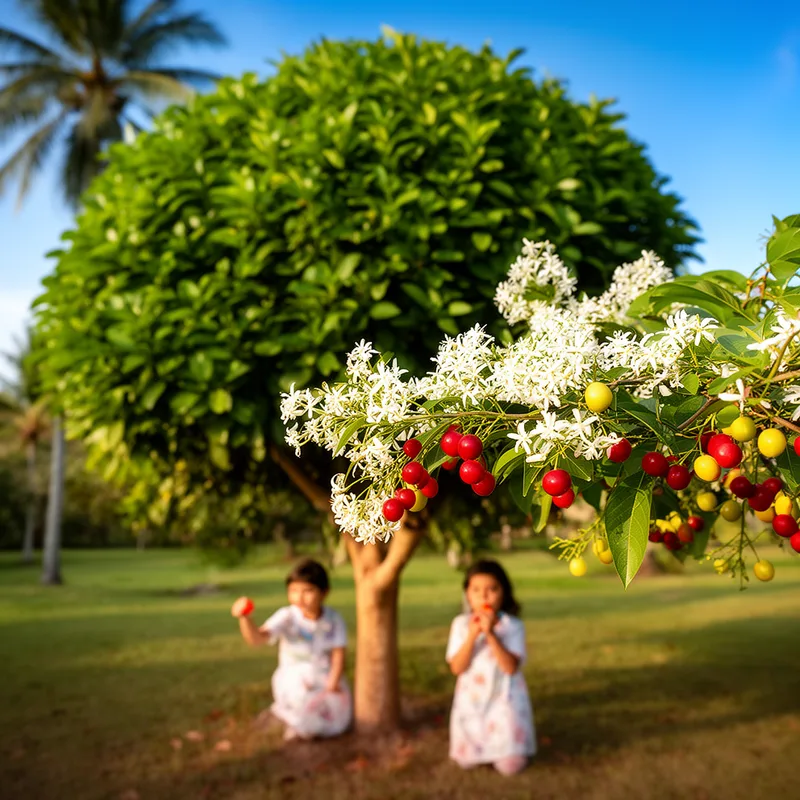
- The fruit of the Muntingia calabura is sweet and popular with children in tropical regions.
Examples
-
Many gardeners plant Muntingia calabura as a fast-growing shade tree in warm climates.
-
The bark of Muntingia calabura yields a strong fiber used locally for making ropes.
-
The Muntingia calabura tree can grow up to 10 meters tall.
-
Have you ever tasted the fruit of the Muntingia calabura?
-
Many gardeners plant Muntingia calabura as a fast-growing shade tree in warm climates.
-
The fruit of the Muntingia calabura is sweet and popular with children in tropical regions.
-
The bark of Muntingia calabura yields a strong fiber used locally for making ropes.
Synonyms

 1
9.9
1
9.9

A fast-growing tropical tree with white flowers and edible fruit and bark that gives silky fibers for rope

A fast-growing tropical evergreen tree with small sweet red fruit that people eat

A tropical evergreen tree with edible fruit, silky bark used to make rope, and wood used for boards

A fast-growing tropical tree that has edible fruit and bark for making strong rope

A fast-growing tropical evergreen tree with white flowers, small sweet red fruit, and bark used to make strong thread
Surface Forms
Morphology
This is a scientific binomial composed of a genus name and a species epithet; if a learner knows 'Muntingia' (a genus of trees) and 'calabura' (a fast-growing tree with edible fruit) they can directly infer it denotes that specific tree species. Botanical names are compositional in this way and function cross-linguistically as straightforward labels for species, so the meaning is derivable from the constituents.
Etymology
Muntingia calabura may come from the name of a plant scientist Muntingia and a local word 'calabura' for the tree's small red fruits. Picture a fast-growing tree covered in sweet, cherry-like berries, and that image helps you remember it is a tropical tree grown for its fruit, fiber, and wood.