

Mt. Everest
 2
2.0
2
2.0

- proper noun
- /maʊnt ˈɛvərɪst/
 :
Monte Everest
:
Monte Everest
- Climb Mt. Everest!
- climb Mt. Everest
- top of Mt. Everest
- summit of Mt. Everest
Examples
-
The breathtaking view from the top of Mt. Everest is like no other.
-
Climbing Mt. Everest is a dream for many mountaineers despite the dangers involved.
-
In 1953, Sir Edmund Hillary and Tenzing Norgay became the first to reach the summit of Mt. Everest.
-
The harsh weather on Mt. Everest can change rapidly, making every expedition challenging.
-
Did you know Mt. Everest is the highest mountain?
-
Many climbers dream of reaching the summit of Mt. Everest during their lifetimes.
-
As the highest mountain in the world, Mt. Everest stands at an impressive 8,848 meters.
Synonyms
 123
1.8
123
1.8
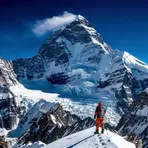
The highest mountain in the world, in the Himalayas on the border of Nepal and China
 10
2.3
10
2.3
The highest mountain in the world on the border between Nepal and China, rising about 8,848 meters
Surface Forms
Morphology
Mt. + Everest
The expression is a straightforward proper-name construction: 'Mt.' is an abbreviation of 'Mount' (a generic label for a mountain) combined with the proper name 'Everest', so it directly denotes the mountain called Everest. This naming pattern is cross-linguistically common and would be immediately understandable to a B1 learner who knows the constituent words or the abbreviation.
Etymology
Mt. Everest is named after Sir George Everest, a British map-maker who helped measure and map the mountains in the 1800s. People put his name on the tallest peak, so Mt. Everest is the name we use for the 'highest mountain' in the world today.