

Mormon cricket
- noun
- /ˈmɔrmən ˈkrɪkɪt/
- US
- During their migration, Mormon crickets often travel long distances in search of food.
Examples
-
In the summer, swarms of Mormon crickets can devastate crops in arid regions of the West.
-
PHOTO (COLOR): A radio transmitter attached to the back of a Mormon cricket helps researchers determine its movement in the field.
Academic text (2004) -
The walking habits of a lone Mormon cricket or grasshopper might seem trivial.
Academic text (2004) -
PHOTO (COLOR): Greg Sword uses a computerized video tracking system to analyze Mormon cricket behavior.
Academic text (2004) -
Sword wanted to find out whether high rearing density could also explain the migrating bands of Mormon crickets that inflict damage each year in the West.
Academic text (2004) -
Many researchers have thought that Mormon crickets—and possibly grasshoppers—behave like their cousins, migratory locusts.
Academic text (2004) -
Farmers are concerned about the arrival of Mormon crickets, which can strip fields bare quickly.
Synonyms
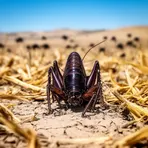
A large dark insect without wings like a cricket that lives in dry western United States
Surface Forms
Morphology
The compound is compositionally built from 'Mormon' (connected with the LDS church/people) + 'cricket' (an insect), so a B1 learner who knows both words can infer it denotes a type of cricket associated with Mormons or that region. Although the precise biological details (large, wingless, swarming) are specialist and not predictable from the parts, the basic referent 'a cricket related to Mormon/Utah context' is directly derivable following normal noun-modifier patterns.
Etymology
Mormon cricket was named after early Mormon settlers in the American West who often found huge, wingless crickets eating their crops in big, moving swarms. That's why the name now means a large, wingless insect that moves in big swarms.

