

Anabrus simplex
- noun
- /ˈænəbrəs ˈsɪmplɛks/
- Specialized
 :
Anabrus simplex
:
Anabrus simplex
- The Anabrus simplex is often mistaken for a grasshopper.
Examples
-
Researchers studied the migration patterns of Anabrus simplex to understand its environmental impact.
-
I spotted an Anabrus simplex while hiking in Utah.
-
Each summer, swarms of Anabrus simplex can devastate crops in the western states.
-
The local ecosystem changed after the population of Anabrus simplex dramatically increased.
-
Each summer, swarms of Anabrus simplex can devastate crops in the western states.
-
Researchers studied the migration patterns of Anabrus simplex to understand its environmental impact.
-
The local ecosystem changed after the population of Anabrus simplex dramatically increased.
Synonyms
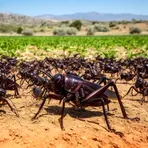
A large dark insect like a cricket that cannot fly and forms moving swarms in the western United States
Surface Forms
Morphology
This is a Latin binomial combining the genus name 'Anabrus' with the species epithet 'simplex', so a learner who knows 'Anabrus' (a large flightless grasshopper) and 'simplex' (single/simple) can infer it denotes a specific species of that genus. However the precise common name and detailed traits (e.g. 'Mormon cricket', native range, being a wingless katydid) are not directly derivable from 'simplex', so the meaning is only partially predictable.
Etymology
Anabrus simplex is the scientific name for the large, wingless insect often called the 'Mormon cricket'. One popular idea is that simplex ('simple') points to its plain, wingless body, and the common name 'Mormon cricket' came from early settlers who saw huge swarms eating crops, so the name helps you remember this big, crop-eating, wingless katydid.

